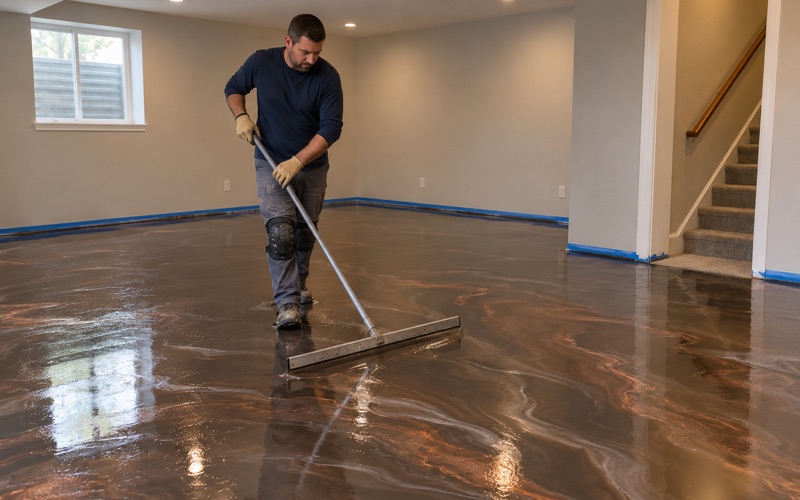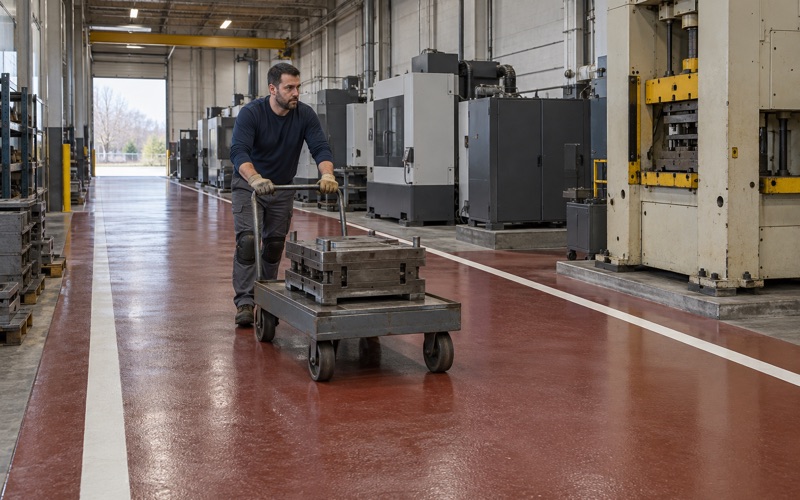
New Berlin Epoxy Flooring has spent more than 20 years putting epoxy flooring in Sussex and across Waukesha County onto slabs that have to stay clean under whatever sits on them. That includes warehouse and production floors where stock stands directly on the concrete, and home garages that take a full winter of tire spray. Each job starts with the slab itself, not with a color chart.
Before we quote, we look at the cracks, joints and any old coating, and we tell you plainly if the concrete needs repair or replacement first. The proposal then names the product, the system build and the finished thickness, so anyone on your side can check what was quoted against what went down. Warranty exclusions are read out before the job is sold, with moisture from below named first.
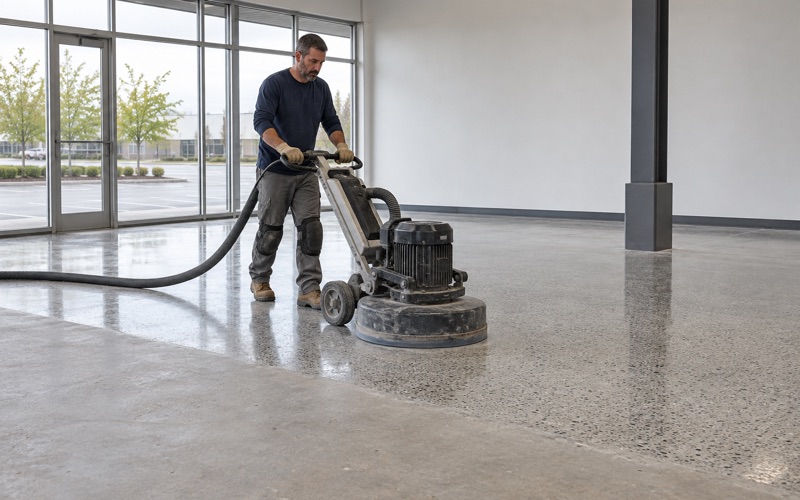
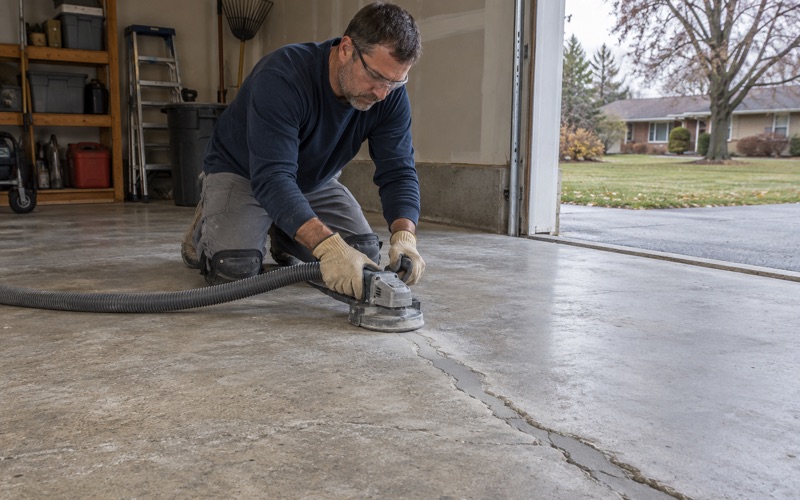
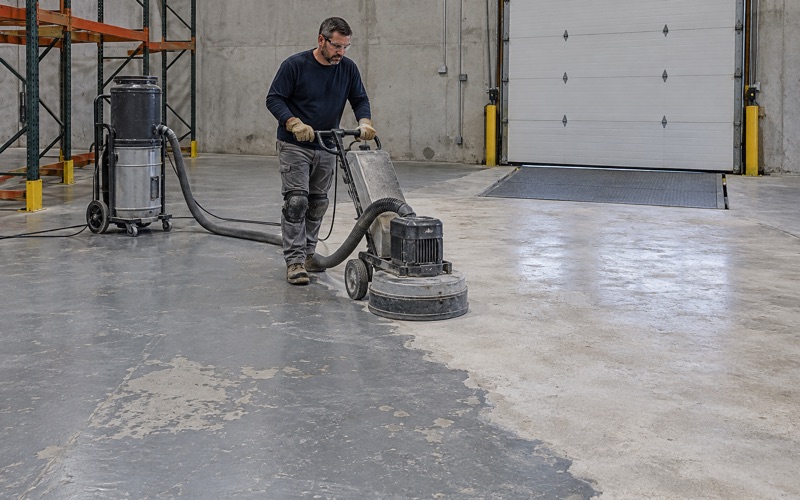
Preparation is mechanical every time. A diamond grinder or shot blaster opens the slab to the profile the coating calls for, and we never acid etch. Moisture testing sits inside the scope rather than being offered after a floor has blistered, and curing is timed against slab temperature and dew point instead of the calendar. Grinding dust and slurry are collected on site and never sent down a floor drain.
A Printing Town, and a Press That Runs on Rolls
Sussex has a clear industrial identity, and it is print. Quad’s global headquarters sits at N61 W23044 Harry’s Way, and its flagship campus is both corporate offices and a production facility of about 1.5 million square feet. That one fact shapes how we think about floors in this village, because a printing operation is a paper-handling operation long before it is a press.
Quad’s Flagship Campus on Harry’s Way and Main Street
Quad was founded in 1971 in Pewaukee and grew into the company headquartered here. Its Sussex print manufacturing facility sits along Main Street, and a December 2025 report described that plant as still operational. Quad is a neighbor and a landmark to us, not a client we are claiming; what interests us is the kind of floor its industry depends on.
The company’s own property moves show how much room paper takes. In 2014 Quad leased a 99,740-square-foot former warehouse on Duplainville Road in Pewaukee for warehousing, with paper roll storage given as an example of its use. Roll stock needs dedicated floor area, and that area has to meet a standard of its own before a single roll is set down.
Why a Press Floor Is Really a Roll Floor
A web press feeds from large rolls of paper rather than cut sheets. Those rolls arrive by truck, wait in storage, travel to the press on handling equipment and stand near the feed while a run is set up. At every one of those stops the roll is resting on concrete, so the slab is part of the paper’s handling path, not just the ground the press is bolted to.
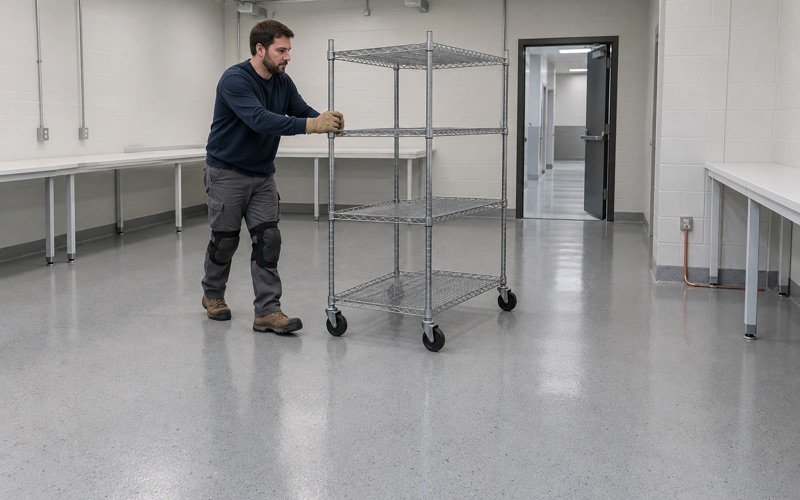
That is why roll storage and press-feed areas are treated differently from a general warehouse aisle. The floor there is expected to be cleanable, non-dusting and free of oil, and any stained patch is dealt with before rolls are placed, not after. Those are surface conditions a densifier or a coating system can address, which is where our work fits in.
Across Main Street, a Building Changing Hands
Quad sold its High Tech Centre at N64 W23110 Main St., about 200,000 square feet on 34 acres, to Generac Power Systems for $20 million. Generac announced in January 2026 that it would expand commercial and industrial manufacturing there, with an opening planned for the fourth quarter of 2026. A building converting from support space to production is exactly the moment its floors get a second look.
Looking for epoxy-flooring closer to Mukwonago? See Epoxy-Flooring Services in Mukwonago.
Dry and Clean: What Roll-Handling Rules Ask of a Floor
There is no Quad document on its own floors that we can point to, and we will not invent one. What we can point to are published roll-handling rules from outside the print plant: a marine terminal’s acceptance guideline for break-bulk paper and a freight handling code. Neither names a coating, but both are specific about the condition of the floor the rolls stand on.
Rolls Stored on End Sit on Their Edges
The terminal guideline says all rolls shall be placed on a dry and clean warehouse floor, and it prefers on-end stacking as safer and better for the condition of the paper. It also limits stacks to no more than four full-size rolls and asks that shed doors stay closed whenever possible. Those are the conditions a roll-storage floor is judged against.
Standing a roll on end has a consequence that is easy to overlook. The full weight of the roll rests on the edge of the paper, and that edge is in direct contact with the slab. Anything on the concrete surface, whether fine dust, a film of oil, grit or damp, is pressed straight against the paper the press will eventually unwind.
Clean the Floor First, Then Set the Rolls Down
The freight handling code reads like a floor-prep checklist. Clean the floor first, check for nails, wood chips and similar debris and remove them, and make sure wet oily stains are removed or, if they are dry, covered with paper. It also says to store rolls in a secure dry area away from any source of dampness and to keep them clear of forklift lanes.
Every one of those steps is easier on a sealed surface than on bare concrete. An oil spot that has soaked into an open slab cannot really be removed, only covered, and it can wick back toward the surface over time. On a coated floor the same spill sits on top, where a mop lifts it before rolls arrive. The code also asks that rolls kept more than seven days be covered against dust, stains and sunlight.
Kraft Paper Underneath Is a Backup, Not a Fix
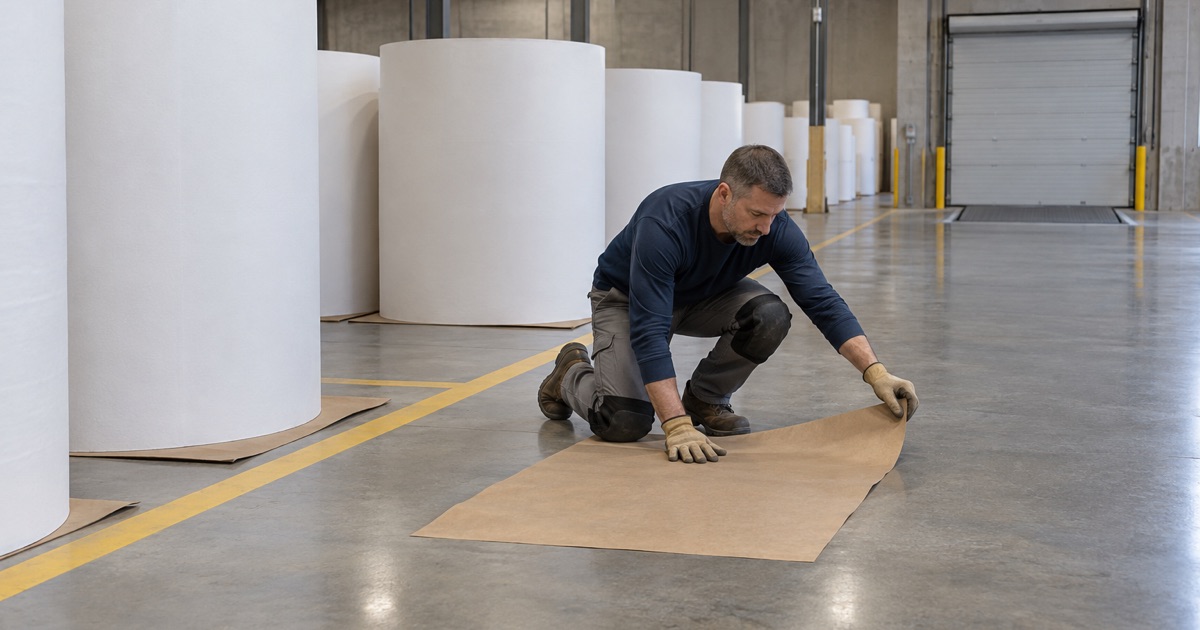
The terminal rules allow a layer of heavy kraft paper under the rolls when required. That underlay is a sensible barrier, but it is a consumable that tears, shifts under handling equipment and soaks through where the slab is damp. We treat it as a second line of defense for a floor that is already clean and dry, rather than a cover over a slab that is shedding or stained.
Dust, Oil Spots and Damp: What an Edge-Standing Roll Picks Up
Each of the three contaminants that matter on a roll floor comes from a different place, so each one gets its own answer. Dust comes from the slab surface, oil comes from equipment and traffic, and damp often comes from below. A coating plan that treats them as one problem usually leaves at least one of them behind.
Dust From an Unsealed Slab
Bare concrete keeps releasing a fine powder as forklift wheels and foot traffic wear down the surface paste. Sweeping does not stop it, because the floor is generating the dust rather than merely collecting it. In a roll area that powder settles on the floor and is picked up by the edge of the next roll stood on end.
There are two ways to make a slab non-dusting. A lithium silicate densifier hardens the top of the concrete and cuts dusting, while a 100% solids epoxy or urethane cement system seals the surface outright and gives a floor that can be wet-cleaned. Which one fits depends on how much chemical, oil and wheel traffic the area sees, and we explain that tradeoff in the proposal.
Oil Spots and Stains That Come Back
Oil is the contaminant the freight code singles out, and it is also the one that most often ruins a coating. A coating laid over oil-soaked concrete loses adhesion and lifts in exactly the patch where the stain was. That is why stained areas are ground out or treated before we prime, and why we will not promise a bond over a spot we have not been able to clean.
Once the floor is sealed, the cost of a spill changes. Hydraulic fluid or a drip from a lift truck stays on the surface, where it can be wiped up the same shift instead of becoming a permanent dark patch. In roll storage that means the floor can be returned to dry and clean quickly, which is the condition the handling rules ask for every time rolls go down.
Damp Coming Up Through the Concrete
A slab can look dry and still carry moisture vapor up from below, and paper is unforgiving of damp. We measure rather than assume, using ASTM F2170 in-situ relative humidity probes or ASTM F1869 calcium chloride testing depending on the slab. Where readings are high, a moisture-mitigation primer goes into the scope, and we say plainly that no coating is a cure for water rising through a slab.
Preparing Sussex Plant, Warehouse and Garage Floors
The sequence matters as much as the product. Stains, damaged joints and weak concrete are handled first, the surface is opened to the profile the system needs, and only then does a coating go down. Getting that order right is how a roll floor ends up dry, clean and non-dusting rather than freshly coated over the problems it already had.
Grinding, Joints and Repairs
We open the slab with diamond grinding or shot blasting to an ICRI CSP profile matched to the coating, never acid etching. That removes the weak surface paste that dusts, exposes contamination hidden under it and gives the primer something to bite into. Old coatings and failed patches come off in the same pass, so nothing loose is left under the new system.
Plant and warehouse joints get a semirigid joint filler before any coating crosses them. Forklift and cart wheels hammer an open joint, and a broken joint edge is both a source of grit and a jolt for the equipment carrying rolls. Where a slab is cracked badly enough to need repair or replacement, we tell you that before quoting any coating at all.
Working Around a Running Production Schedule
Industrial floors are scheduled around production, using shift breaks, weekends or a shutdown week rather than asking a plant to stop for us. Grinding dust is captured by vacuum at the machine and slurry is collected on site, never washed into a floor drain or a storm sewer. In a building full of paper, controlling our own dust is part of the job.
Cure timing follows slab temperature and the dew point spread at the surface, not a fixed number of days. Coating too close to the dew point invites amine blush, and a slab that is still outgassing can leave pinholes in the finish. We would rather add a day to a schedule than hand back a floor that has to be redone with rolls already stacked on it.
Sussex Home Garages Get the Same Discipline
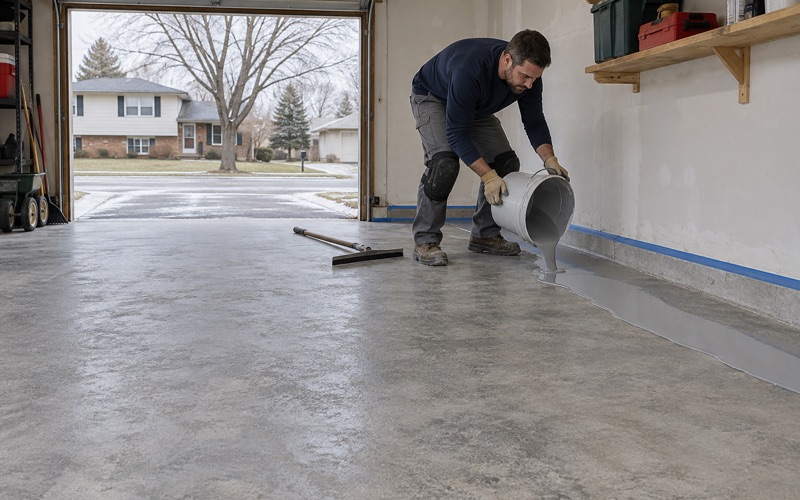
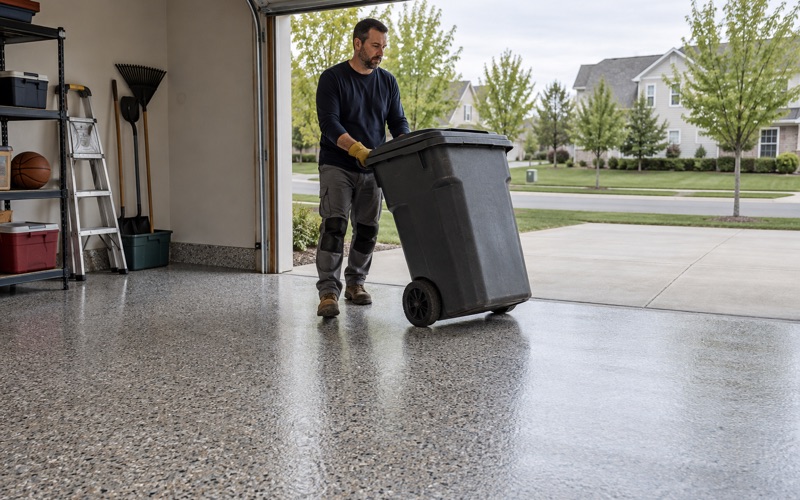
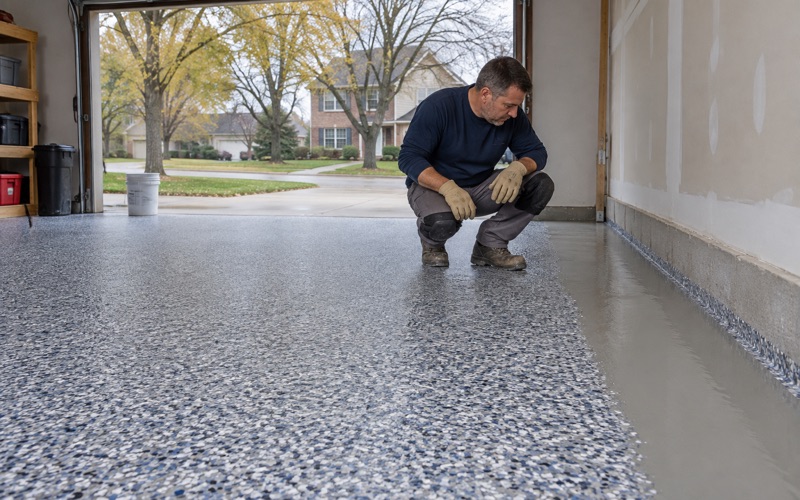
Most owner-occupied homes in the village are detached houses, and their garage floors face a different kind of wear. Road salt and calcium chloride brine ride in on the tires all winter, and a dry-looking slab can still carry moisture because Wisconsin does not require a vapor retarder under an unconditioned attached garage. We test before we coat, and every home job gets a written contract before any deposit, with the products and warranty in it.
- 20+ Years on Concrete
- Moisture Testing in Every Scope
- Written Contract Before Any Deposit