New Berlin Epoxy Flooring has spent more than 20 years on epoxy-flooring in St. Francis and across the Milwaukee area, and some of the garages we coat are not just for cars. When a garage holds a small business as well as a vehicle, the floor is doing three jobs at once. It has to store stock, take spills from the work, and still clean up like a garage.
That changes how we specify the system. A two-car slab that only sees tires can be judged on salt, hot tire pickup and wear. A slab that also carries shelving, a workbench and finished goods waiting for a buyer needs a surface that will not stain from the craft, will not let moisture wick into cardboard boxes, and gives a broom something smooth to work against.
Before any quote, we walk the slab, read the cracks, joints and any old coating, and tell you plainly when it needs repair first. The written proposal then names the product, the system build and the finished thickness, so you can check what went down against what you paid for. The sections below explain why a garage-based business here asks more of its floor.
A Home Business in a St. Francis Garage
St. Francis is a small city of 9,161 people at the 2020 census, set along Lake Michigan in Milwaukee County. Detached single-family homes make up 45 percent of its housing, and 80 percent of owner-occupants live in one. Many of those homes have a garage, and the city’s zoning code is unusually specific about what can happen inside one when a resident runs a business from home.
What Section 455-44 allows
St. Francis Code Section 455-44 permits home occupations in single-family and two-family dwellings, provided the business stays incidental to living there and the people running it live on the premises. Subsection C(5) says the work ‘shall be conducted entirely within the principal residential building or in a permitted private garage accessory thereto.’ That last phrase is what puts a business on a garage floor.
The code also says no alteration may change the building’s character as a dwelling, and it allows no more than two home occupations per dwelling unit. It is silent on floors and coatings, so the floor is your decision and ours, not the city’s. A coating still leaves the garage what it was: it parks a car, and from the street it reads as a house with a garage.
What the code keeps indoors
The same section sets out what stays inside. Subsection C(8) reads: ‘There shall be no outside storage of materials, supplies, products, equipment or anything else associated with the home occupation.’ Subsection C(6) allows no stock-in-trade except articles produced on the premises, and C(7) caps the display at three products within a 16-square-foot footprint, no more than 8 feet high.
Put those together and a garage workshop becomes a storeroom, a workroom and a small showroom sharing one slab. Raw materials sit along one wall, the work happens in the middle, and the finished pieces wait near the door. Nothing spreads onto the driveway or the side yard, so everything the business owns, and everything it drips, ends up on the concrete.
The house behind the garage
More than half of the housing in St. Francis went up before 1970, with 1,306 units built in the 1950s alone. We never assume a slab from that era has a vapor retarder under it, and the Wisconsin Uniform Dwelling Code does not require one under an unconditioned attached garage slab even now. So we test before we coat, because a business stores things on that slab that a car never minded.
Looking for epoxy-flooring closer to Cudahy? See Epoxy-Flooring Services in Cudahy.
No Outside Storage: The Slab Holds the Stock
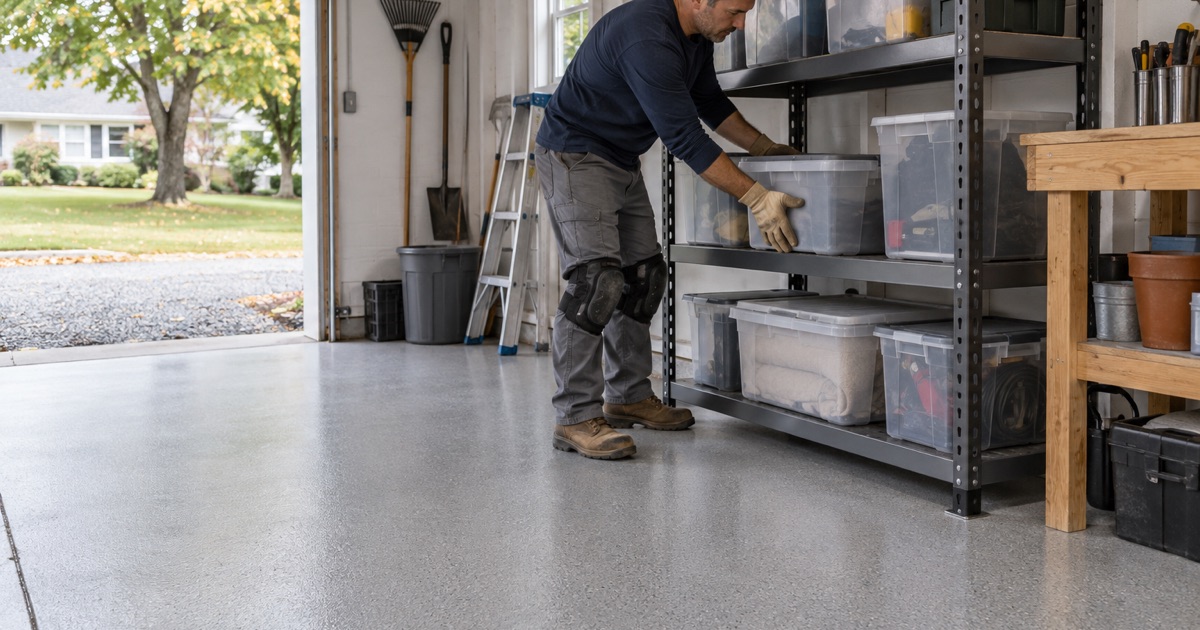
Because C(8) rules out storing anything tied to the business outdoors, there is no overflow shed and no tarp pile by the fence. Shelving units, bins of supplies, boxed finished goods and the tools themselves all stand on the garage floor, often for months at a time. That puts a different load on a coating than parked tires do, and it is where the moisture question stops being academic.
Testing before stock sits on the slab
Moisture testing is written into every garage scope we quote, not sold afterward. We start with an ASTM D4263 plastic sheet test, and where the slab warrants it we run ASTM F1869 calcium chloride tests or ASTM F2170 in-situ relative humidity probes. A slab that passes looks the same as one that fails, which is exactly why we measure instead of guessing.
Moisture from below is the first warranty exclusion we read out before you sign, and we name it plainly. If the readings come back high, a moisture-mitigation primer goes into the system under the epoxy, or we tell you the slab is not a candidate. We do not sell a floor coating as a fix for water coming up through concrete, and we do not pretend a coating reduces radon.
Stacked boxes and cardboard
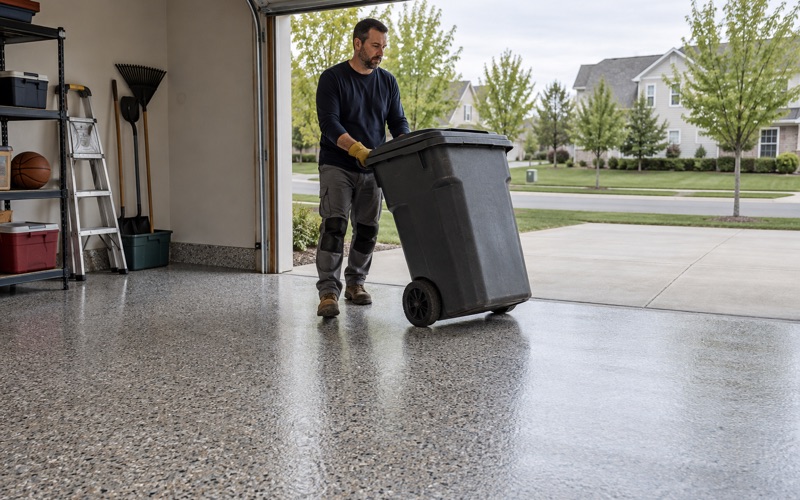
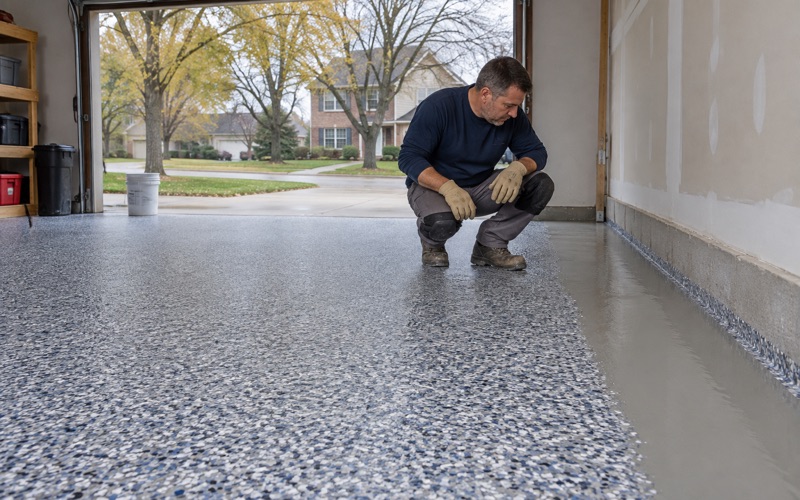
Cardboard set on bare concrete pulls in moisture and picks up the gray dust a worn slab sheds. A sealed 100% solids epoxy base stops the dusting and gives boxes a surface that stays dry when the slab itself is dry. We like a vinyl flake broadcast for storage zones, because it hides the scuffs that shelving feet and hand trucks leave as stock moves in and out.
Heavy shelving needs real build under it, so the proposal states the finished thickness rather than a vague number of coats. Where shelving bolts to the slab, we plan the anchors for after the coating cures, so a drill never chips the edge of an uncured film. Cracks and control joints under the racks are repaired and filled before anything goes over them.
The three-product display
Subsection C(7) allows no more than three products displayed, in a footprint no larger than 16 square feet. For a maker selling articles produced on the premises, that small corner of the garage is the showroom. A clean, glossy floor under it makes a better impression on a customer than oil-stained concrete, and a polyaspartic topcoat keeps that gloss from yellowing in the light from an open door.
Household Tools, So a Residential-Grade Floor
Subsection C(4) says ‘No mechanical or electrical equipment other than normal domestic or household equipment shall be used.’ That rules out industrial machinery and points the floor toward a residential garage system. There are no forklifts, no pallet jacks running shifts and no heavy plant equipment to design around, so the job is a well-built residential floor chosen for the particular spills of the craft.
Matching the coating to the spill
Every home business spills something different. A woodworker drops finish and glue, a candle maker drips wax, a screen printer splashes ink, and a small-engine hobby leaks oil. We ask what the work involves before choosing a topcoat, because polyaspartic, polyurea and epoxy topcoats each resist some solvents and chemicals better than others, and the one we choose is named in the proposal.
The broadcast matters too. A full vinyl flake broadcast hides drips between cleanings, while a quartz aggregate broadcast adds grip where wet work happens near the bench. Smooth looks easier to wipe, but a little texture keeps feet steady on a floor that sees spilled finish or water. We set the texture to the work, not to a showroom photo.
Grinding before anything is applied
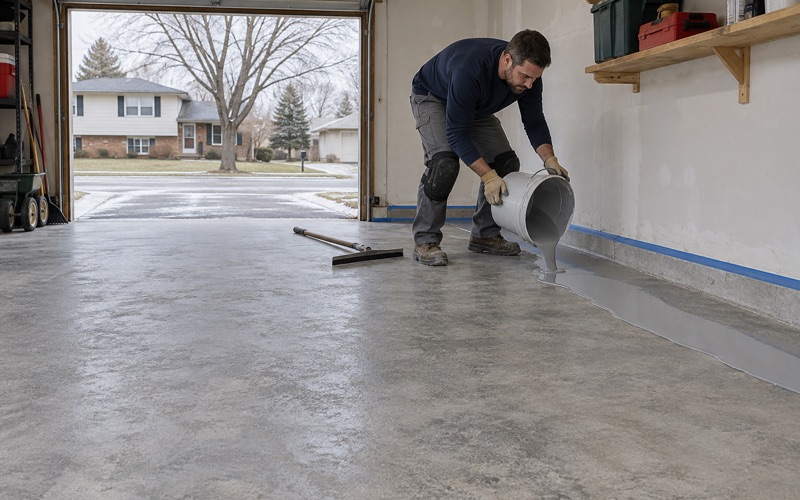
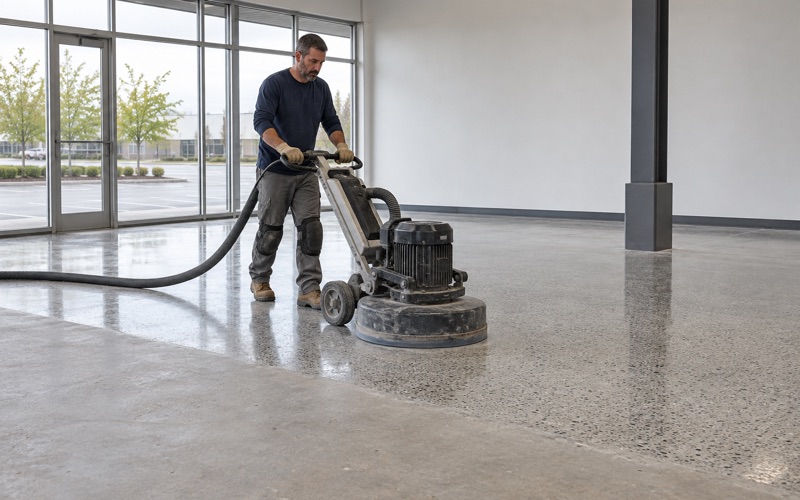
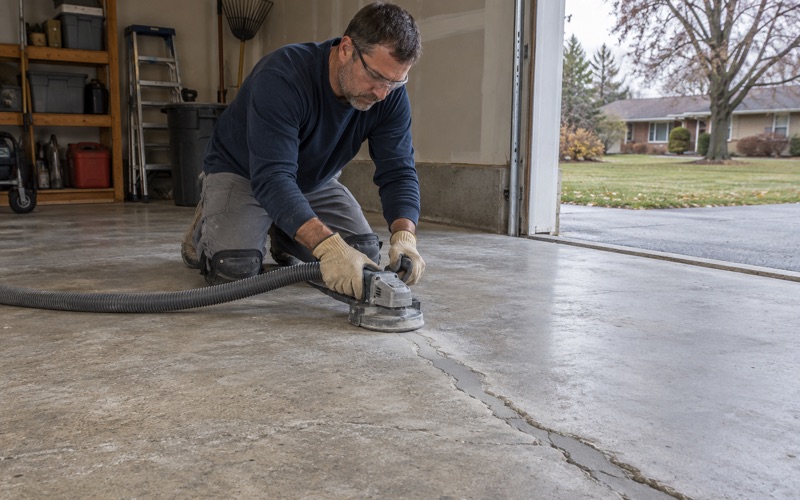
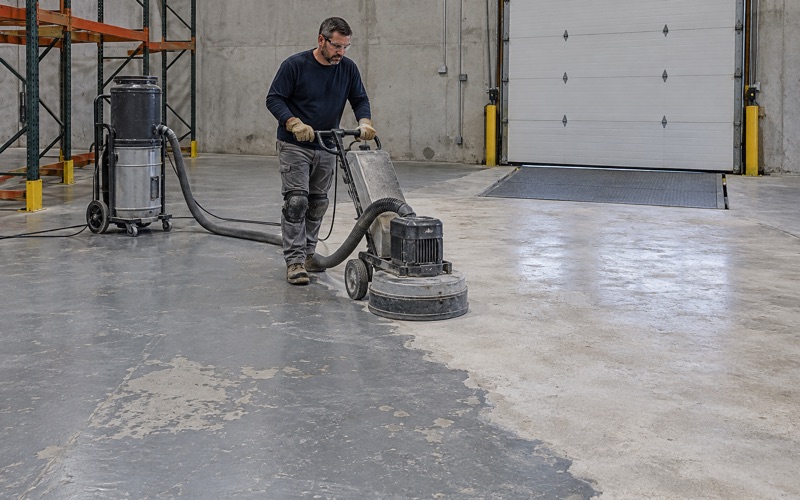
Household-grade use does not mean household-grade prep. Every slab we coat is opened with a diamond grinder or a shot blaster to a measured ICRI CSP profile, and we never acid etch. Old sealers, paint and oil-soaked patches come off in that step, because a coating holds only as well as the concrete surface it bonds to.
Grinding dust and slurry are collected on site and never washed into a floor drain or a storm sewer. For a garage that will later hold stock, that also means the finished surface starts clean. We leave no fine grit in the corners waiting to settle onto boxes and shelves once the coating has cured and the business moves back in.
Winter and curing
The car still uses the garage, so road salt and calcium chloride brine still come in on the tires every winter. We build garage floors for those deicers, which matters even more when the same floor holds materials that salt water should never reach. Curing is scheduled against slab temperature and dew point rather than the calendar, and an unheated garage sometimes waits for spring.
Sweeping In, Not Out: Dust Stays on Your Side of the Line
Subsection C(11) bars any public nuisance and any ‘offensive noise, vibration, smoke, dust, electronic interference, odors, heat or glare spilling over the property line.’ The stated purpose of the whole section is to protect the passive nature of residential districts. For a garage workshop, the practical result is that sawdust and scraps get swept up inside, not pushed out the door onto the driveway.
A floor that gives up its dust
Bare concrete holds dust in its pores and sheds more as it wears, so sweeping it never quite finishes. A sealed, coated slab lets a broom or a shop vacuum pull everything off in one pass. Turning the coating a few inches up the base of the walls, rather than stopping it short, keeps debris out of the seam between floor and wall where it otherwise packs in.
We also look closely at the garage door threshold, where the slab meets the apron outside. A coating that ends cleanly at the door gives a dustpan an edge to work toward. Sweeping toward the back of the garage, rather than out toward the street, becomes the easy direction, which is the habit C(11) asks of anyone running a business beside neighbors.
Odor during installation
Odor is named in the same subsection, and installation is the moment a coating smells. We favor 100% solids epoxy and low-odor polyaspartic systems, chosen within the 40 CFR 59 Subpart D national architectural coatings rule. Milwaukee County sits in an ozone nonattainment area, but Wisconsin has no separate state architectural-coating VOC rule, so the federal rule is the one that governs the products.
We ventilate during application and plan the work for days when the door can stand open without dew forming on the slab. Once cured, the floor gives off nothing. Your neighbors notice a day or two of work, not a lasting smell, and the business goes back to running inside a garage that looks like every other one on the block.
Questions for City Hall
Whether a particular home business needs any approval from the city is a question for the City of St. Francis, not for us. The Building Inspection Department is at City Hall, 4235 S. Nicholson Avenue, (414) 481-2300. We ask the local inspector whether the floor work itself needs a permit before we schedule it, and every home job gets a written contract before we take a deposit.
- 20+ Years on Concrete
- Moisture Testing in Every Scope
- Written Contract Before Any Deposit