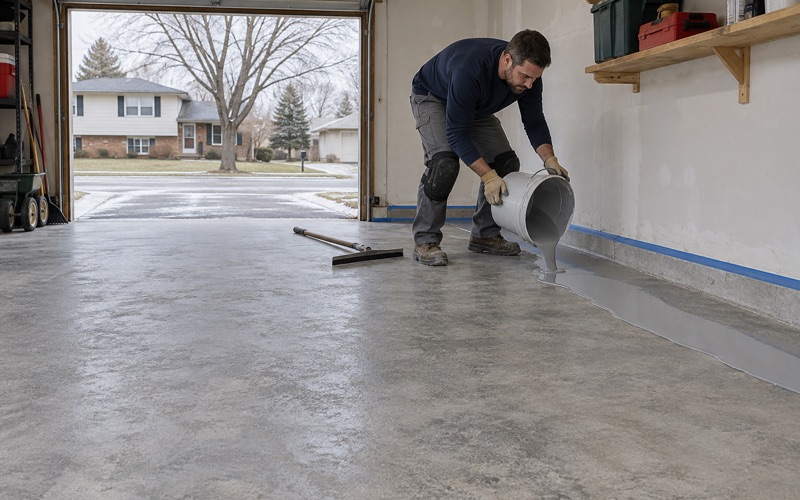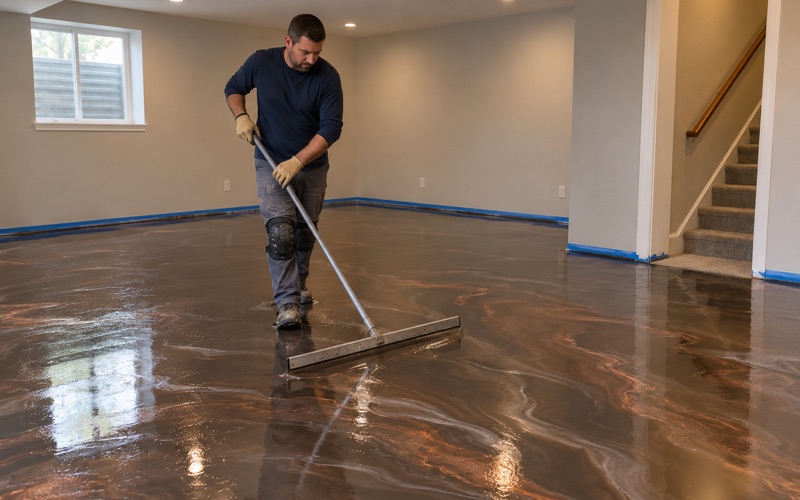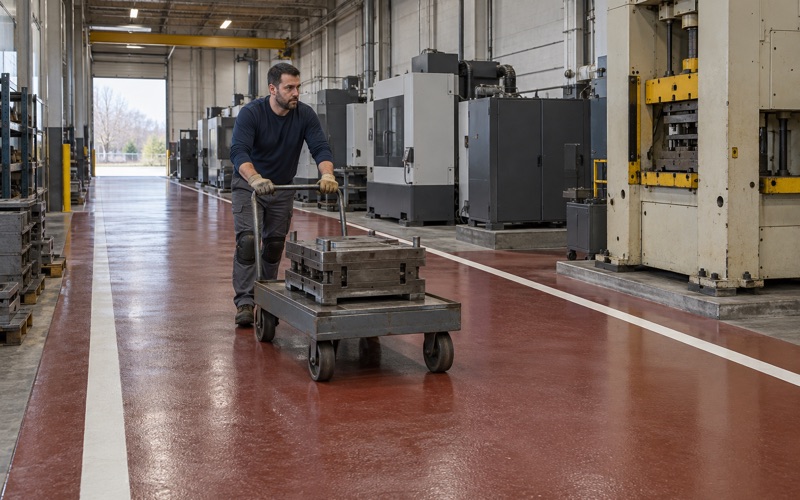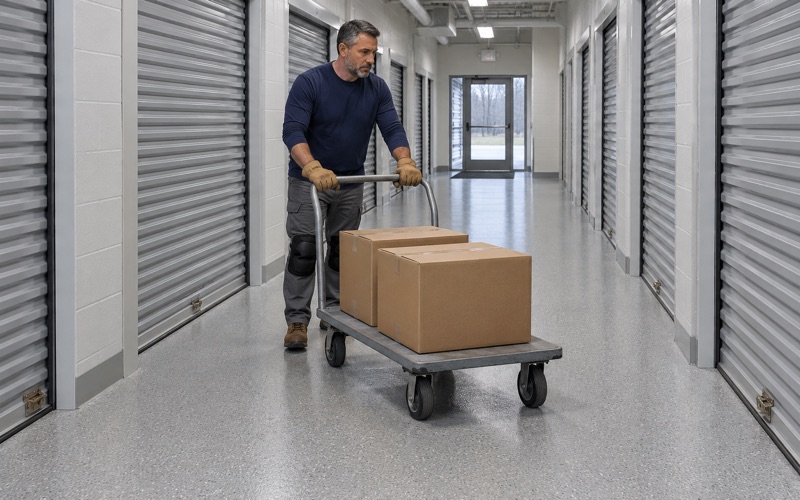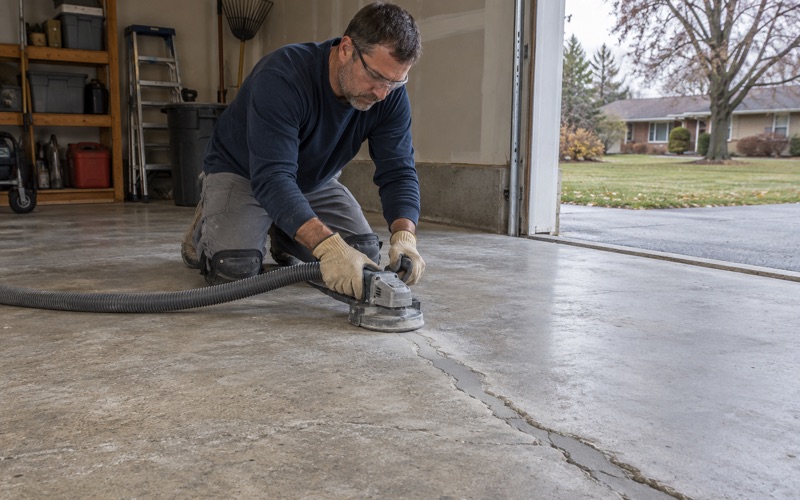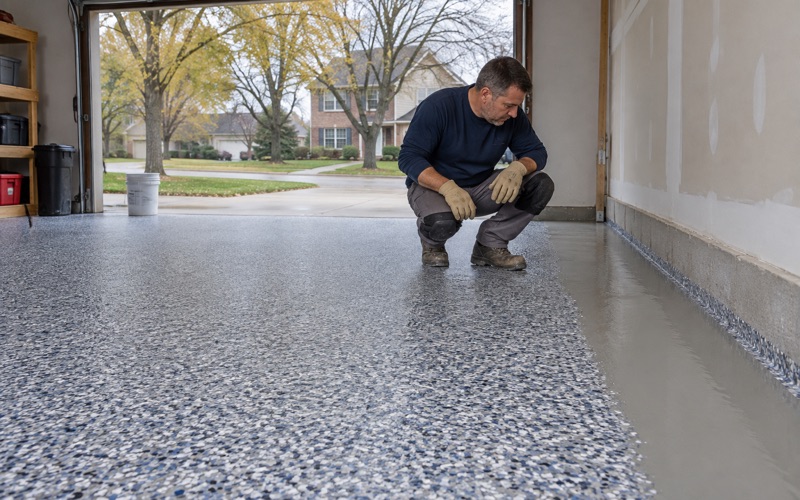
New Berlin Epoxy Flooring has spent more than 20 years on epoxy-flooring in Pewaukee and across Waukesha County, and the floors that teach us the most are the ones people move fast across. Commercial venues, shop floors and busy garages all share one demand: a coating that stays bonded as one continuous layer. We plan every Pewaukee job around that requirement before anyone talks about color or flake.
Our proposals name the product, the system build and the finished thickness, so an owner or a facility manager can check what went down against what was quoted. Before pricing, we read the cracks, the joints and any old coating on the slab. When a floor needs repair or replacement before it can carry a coating, we say so in writing rather than burying it in fine print.
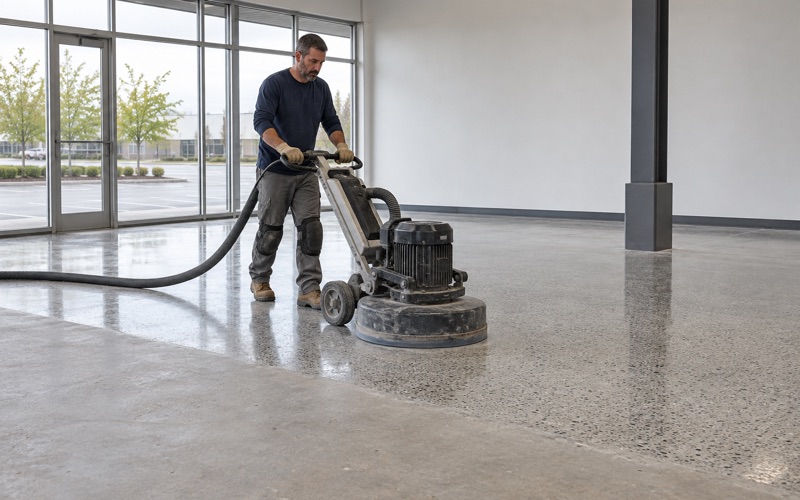
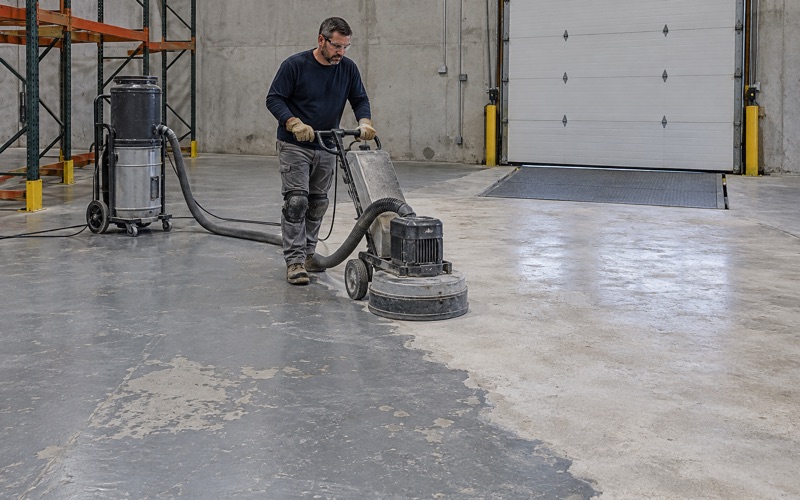
Every slab we coat is opened mechanically with a diamond grinder or a shot blaster, and we never acid etch. Moisture testing is part of the scope from the start, using ASTM F1869 calcium chloride kits or ASTM F2170 in-situ relative humidity probes. Grinding dust and slurry are collected on site, so nothing from our work reaches a floor drain or a storm sewer.
An Indoor Kart Track Off Westwood Drive
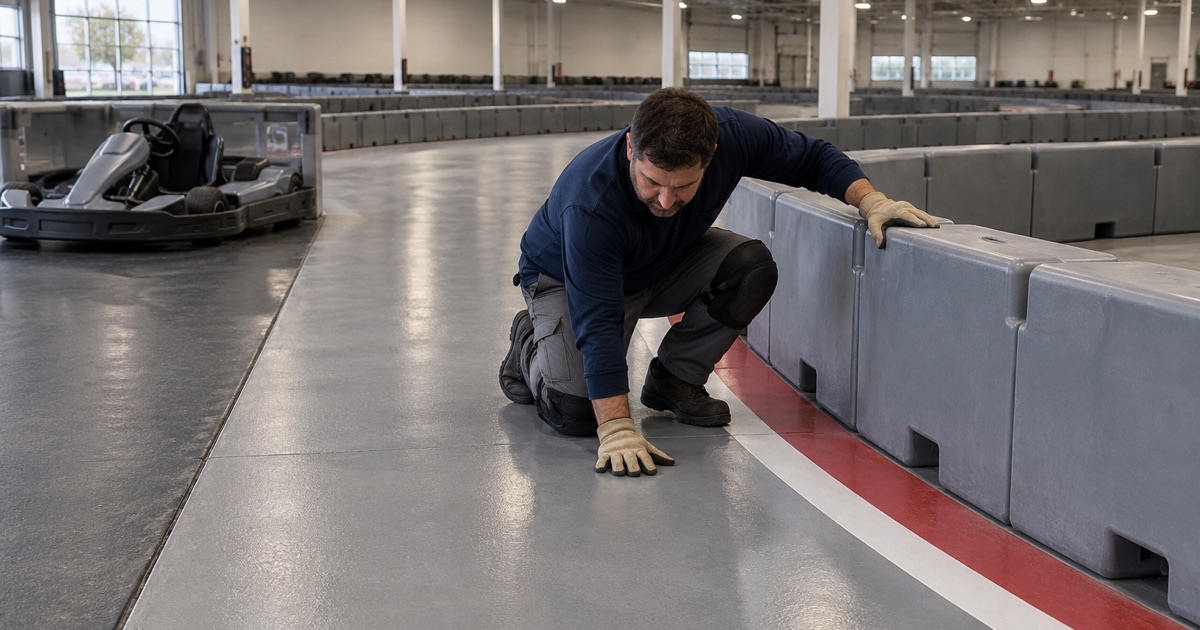
One Pewaukee building shows better than any other why bond and continuity matter. K1 Speed on Westwood Drive runs two indoor electric kart tracks, with adult and junior karts approaching 45 mph, and on Wednesdays and Thursdays the two courses are joined into a single Super Track. A floor in a building like that is not a showroom surface. It is the course itself.
A Waukesha Address Inside the City of Pewaukee
The track’s address reads W229 N1400 Westwood Drive, Waukesha, yet the parcel geocodes inside the City of Pewaukee. That matters to anyone planning floor work in the area, because the mailing city on an envelope does not tell you which building office reviews a job. The City of Pewaukee is also a separate municipality from the Village of Pewaukee at the east end of Pewaukee Lake.
Before we schedule commercial work along this corridor, we confirm the jurisdiction and ask City of Pewaukee Building Services whether the job needs a permit. Their office sits at City Hall, W240 N3065 Pewaukee Road. Asking first costs a phone call, while guessing wrong can cost a lost weekend on a floor that was meant to reopen to customers on Monday morning.
A Big-Box Slab Turned Race Course
The building has held an indoor kart track since Veloce Indoor Speedway opened there in August 2015, in a former American TV store that had sat vacant until the year before. A retail slab like that was poured for display fixtures, shelving and shoppers on foot. Turning it into a course for electric karts asks a very different job of the same concrete.
Old retail slabs carry their history with them: saw-cut joints placed for aisles rather than a racing line, patched anchor holes, adhesive residue and occasional curling at slab edges. We map all of that before quoting any reused big-box floor in Pewaukee. Every crack and joint is read in person, and a section that cannot hold a coating is flagged for repair first.
Looking for epoxy-flooring closer to Martin Drive? See Epoxy-Flooring in Martin Drive.
Smooth, Solid and Binding: Wisconsin’s Ride Rules
Wisconsin regulates go-karts offered to the public as amusement rides under SPS 334, with rider-controlled vehicles such as go-karts addressed in SPS 334.45. That section describes what a track surface should be, how its edges are protected and how riders board. It sets the character of the surface rather than a coating specification, and the state approves no particular floor product for a track.
What the Wording Asks of a Surface
SPS 334.45 calls for a track of hard, cohesive paving such as concrete or asphalt that is smooth and of a solid and binding material. Each of those words reads as a floor requirement. Smooth rules out ridges, trowel marks and raised patches, while solid and binding means the surface holds together as one mass rather than shedding particles under load.
Where speeds exceed 8 mph, the code also calls for a track at least three vehicle widths across, and it rules out intersecting course layouts. Those are layout decisions for the operator and the ride designer, not for a coating crew. What a coating contractor controls is whether the finished surface stays smooth, solid and binding across every square foot of that width.
No Flaking, Lifting or Loose Broadcast
Once a coating goes down on a kart course, it becomes part of the ride surface. It has to stay bonded and continuous, with no flaking, no lifting at the edges and no loose broadcast left sitting on top. A chip of failed coating on a showroom floor is cosmetic. On a track, it is debris on the racing line.
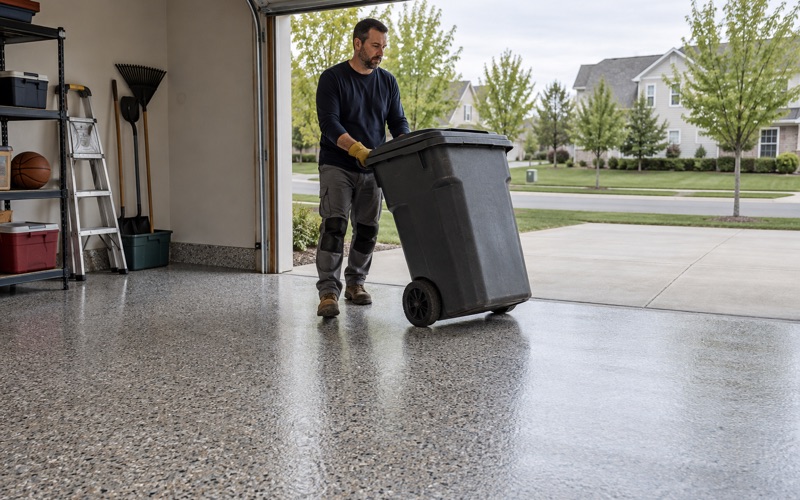
That is why our preparation on a commercial slab aims for a measured ICRI CSP profile matched to the system, rather than a quick scuff. A 100% solids epoxy base needs a clean, open surface to bond to, and any vinyl flake or quartz aggregate broadcast is swept and vacuumed off before the topcoat locks the remainder in place. Nothing loose stays behind.
Outgassing, Pinholes and Moisture From Below
Old retail concrete can outgas when a coating is rolled on while the slab is warming, leaving pinholes that become weak points in the film. We watch slab temperature and the dew point spread at the slab surface before every coat, and we schedule curing against those readings rather than the calendar. Priming as the slab cools reduces that risk considerably.
Moisture from below is the other common cause of lifting. Warranty exclusions are read to the owner before any job is sold, and moisture is the first one we name. We do not sell a floor coating as a fix for water coming up through a slab. When testing shows a problem, a moisture-mitigation primer goes into the written scope instead.
Barriers, Runoff Strips and the Pit Area
SPS 334.45 asks for a barrier system around the inner and outer edges of a go-kart track for the entire length of the course. The options it lists include guard rail, rubber tires, a runoff strip level with the track surface, or an embankment of friable earth or gravel. Each of those edges decides where a coating starts, stops or changes.
A Runoff Strip Level With the Track
Where a runoff strip borders the course, the code wants it level with the track surface. A coating that ends at the track edge with a built-up lip defeats that in practice, even when the concrete underneath was level. Every coating system has a finished thickness, and where it stops it leaves a step unless the transition is planned.
Our approach is to carry the same system across track and runoff strip, or to feather the termination into a ground-in keyway so the two surfaces finish flush. The proposal states which method we will use, along with the build and finished thickness on each side. An owner can check the flush line with a straightedge after cure rather than trusting a description.
Barriers That Run the Full Length
Full-length barriers are anchored into the slab, and they shape the coating sequence. Coating before the barriers go in leaves anchor holes drilled through a finished film, which can chip at the edges. Coating after they are installed means detailing every base by hand. We settle the order with the operator before the first grinder starts, so the edge under each barrier is sealed.
Barrier lines also tend to sit over the original retail joints in a reused building. We fill joints with a semirigid filler before any coating goes over them, so kart wheels and maintenance carts do not break the edges. Joints are cleaned out, filled, and shaved flush before the base coat, and that step is written into the scope.
The Pit and Loading Area
The code calls for a barrier separating the pit or loading area from the track. That makes the pit a separate zone with its own traffic: riders stepping in and out, staff pushing karts, and charging gear for electric karts. We often treat it as its own coating area, finished against the barrier line rather than run straight through from the course.
Separating the zones also helps a phased schedule. A pit area can be prepared and coated while the course stays in use, or the reverse, without leaving a half-finished edge where riders board. Each phase is laid out on the plan, so the barrier line doubles as a clean construction break between one night’s work and the next.
Pewaukee Entertainment and Commercial Floor Questions
Who Reviews a Commercial Floor Job Here
In the City of Pewaukee, building questions go to Building Services at City Hall on Pewaukee Road, and larger land-use questions run through the Plan Commission and the Common Council. Commercial buildings fall under the 2021 International Building Code as adopted in SPS 361. We ask the city whether a floor job needs a permit before we put it on the calendar.
Amusement ride rules sit with the state rather than the city. SPS 334 plan submittals show floor layouts for each level, so an operator reworking a course may already have drawings on file. We work from those drawings when they exist, and we leave ride approvals to the operator and the state while we handle the slab and its coating.
Working Around Open Hours
Entertainment venues earn their money in the evenings and on weekends, so their floors are usually coated in the gaps. We schedule around closed days and slow weeks, much as we time industrial floors around shift breaks, weekends and shutdown weeks. Fast-curing polyaspartic and polyurea topcoats can shorten a closure when the slab readings support them.
Indoor venues also need ventilation planned during application, especially when other parts of the building stay occupied. Product choices and air movement are worked out in advance, and our coatings are selected to meet the 40 CFR 59 Subpart D national architectural coatings rule. Every product is named in the proposal, so the operator can share it with staff before work begins.
Floors Beyond the Track
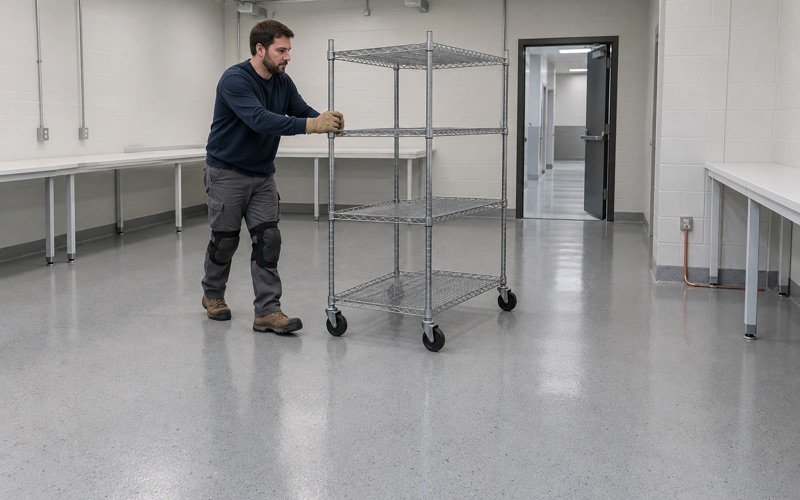
Most Pewaukee floor calls are not race courses. Meeting rooms, party areas, back-of-house corridors and service rooms see heavy foot traffic and rolling carts. For those spaces we often recommend a 100% solids epoxy base with a broadcast and a urethane cement or polyaspartic topcoat, chosen to the room’s traffic rather than to a single house system.
Whatever the room, the order of work stays the same: read the slab, test for moisture, grind or shot blast, fill the joints, coat, and cure to the readings. If a slab needs repair or replacement first, we say so plainly before any price is final. The written scope then shows each of those steps in the order they will happen.
- 20+ Years on Concrete
- Moisture Testing in Every Scope
- Written Contract Before Any Deposit