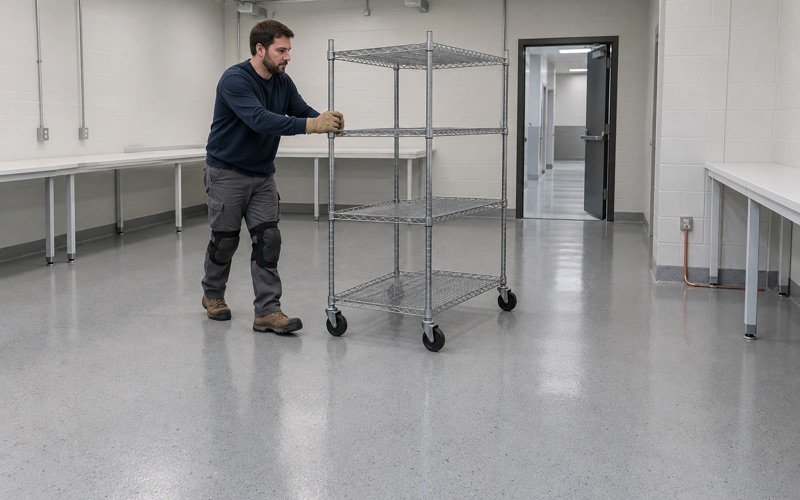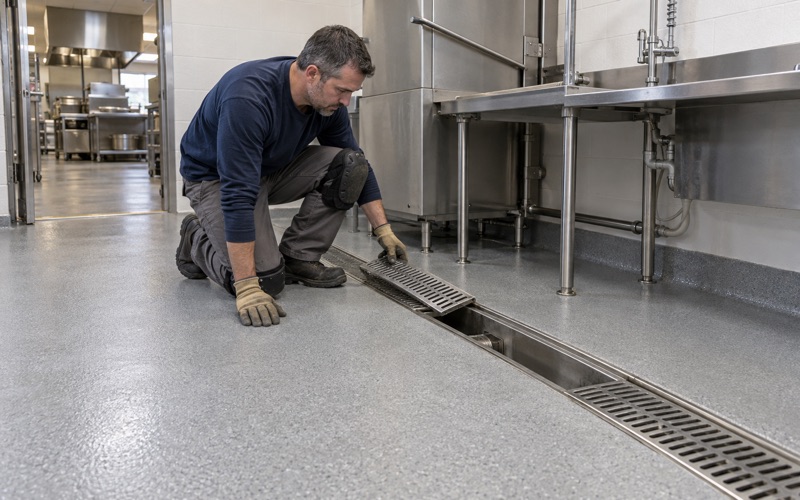
New Berlin Epoxy Flooring has spent more than 20 years putting epoxy-flooring in Oak Creek garages, shops and work bays, and the jobs that teach us the most are the ones where the floor takes a beating every working hour. Truck and fleet repair bays sit at the top of that list. A bay floor there is not judged on its shine; it is judged on how it looks after a year of tractors rolling across it.
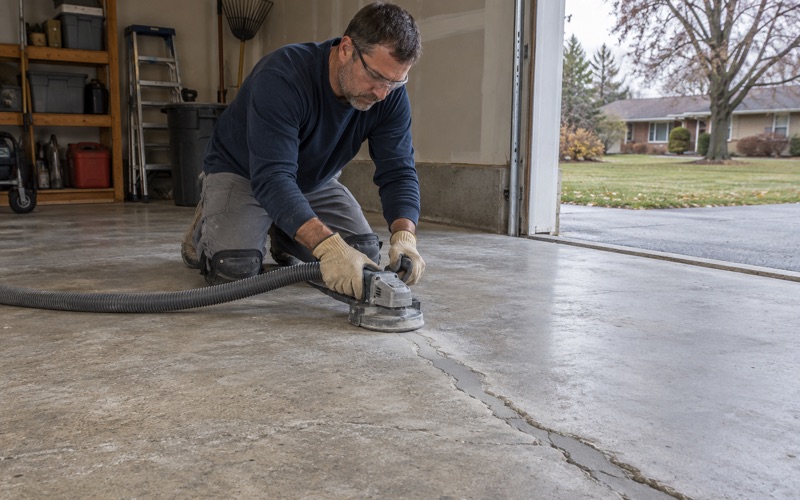
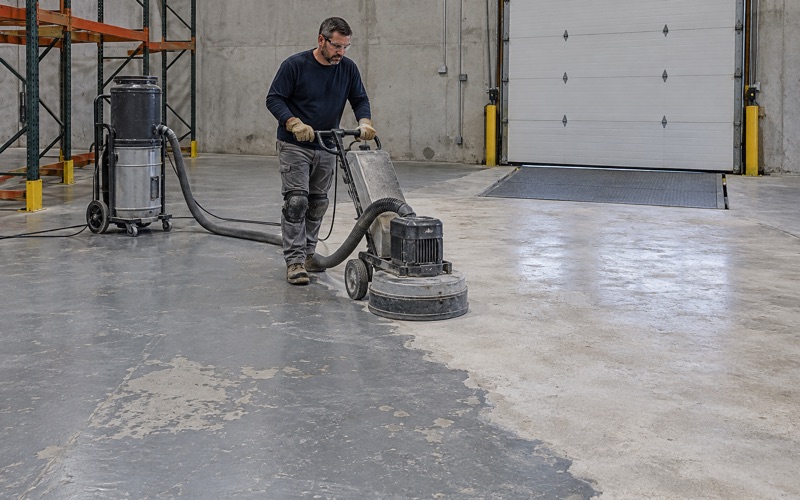
Every one of those floors starts the same way with us. The slab is opened with a diamond grinder or a shot blaster to a measured profile and is never acid etched, because a coating on a truck floor lasts only as long as its grip on the concrete. Our proposal then spells out the product, the system build and the finished thickness, so an owner can check what was quoted against what went down.
This page is about one specific kind of shop: a heavy-truck repair operation fed from an unpaved yard. Before we quote one, we read the cracks, the joints and any old coating, and we say plainly when the slab needs repair before it can carry a new system. Moisture testing is in the written scope from the start, not offered later after a floor has already blistered.
A Semi-Truck Repair Shop on a 6th Street Stone Lot
Oak Creek is a Milwaukee County city on the southwestern shore of Lake Michigan, immediately south of Milwaukee. In 2011 it was one of the fastest growing cities in the county and in all of Wisconsin, and the area has seen an economic boom since. Growth brings trucks, trucks bring shops that repair them, and one approval in 2026 shows the floor problem we want to describe more clearly than any general guide.
What the Plan Commission and Common Council Approved
In July 2026 the Oak Creek Plan Commission took up a conditional use permit for Midwest Fleet Maintenance, a proposed autobody and automotive mechanical repair business with truck and trailer parking at 6925 S. 6th St., Suite 100. After a public hearing the commission voted to recommend approval, and the Common Council approved the permit on Sept. 1. The address sits inside the city, a short way down the same street from City Hall at 8040 S. 6th Street.
The conditions describe a working fleet yard. Outdoor vehicle storage is limited to a designated area on the site plan, with a maximum of 14 semi-tractors and 13 53-foot semi-trailers and nothing else stored outdoors. The approved hours run 24 hours a day, Monday through Friday. We have not seen the building or its floor, and nothing here describes either; what interests us is what the minutes say about the ground outside.
The Answer Was Stone
When the commission asked whether the parking lot was paved or stone, the applicant answered that the lot is stone and said no lot improvements were planned. That single exchange is the reason this page exists. A stone lot is a common, sensible choice for heavy equipment storage, and nothing in the minutes we read suggests the city asked for anything different or set any rule about the floor inside.
For anyone specifying a floor, though, that answer changes the job. A paved yard sheds most of its debris before a truck reaches the door, while a gravel yard sends some of itself indoors with every move. Up to 27 tractors and trailers cycling on and off stone, around the clock on weekdays, adds up to a steady supply of grit headed for the bay.
Other Shops That Park on Gravel
The same pattern turns up well beyond one address on 6th Street. Contractor yards, equipment rental lots, landscaping depots and small fleet shops often park on crushed stone because it drains well and costs less to maintain than pavement. Any Oak Creek owner whose vehicles live on gravel and work indoors faces the same floor question, whatever the size of the fleet.
Looking for epoxy-flooring closer to Glendale? See Epoxy-Flooring Services in Glendale.
What Tires Carry In From a Gravel Yard
We want to be careful about what is actually known here. We found no test data measuring how tread-carried stone wears a coated floor, so what follows is trade practice and owner experience rather than laboratory results. It is consistent, though, and it lines up with what we see whenever we grind off a worn shop coating and look at where the damage concentrates.
Stones in the Treads
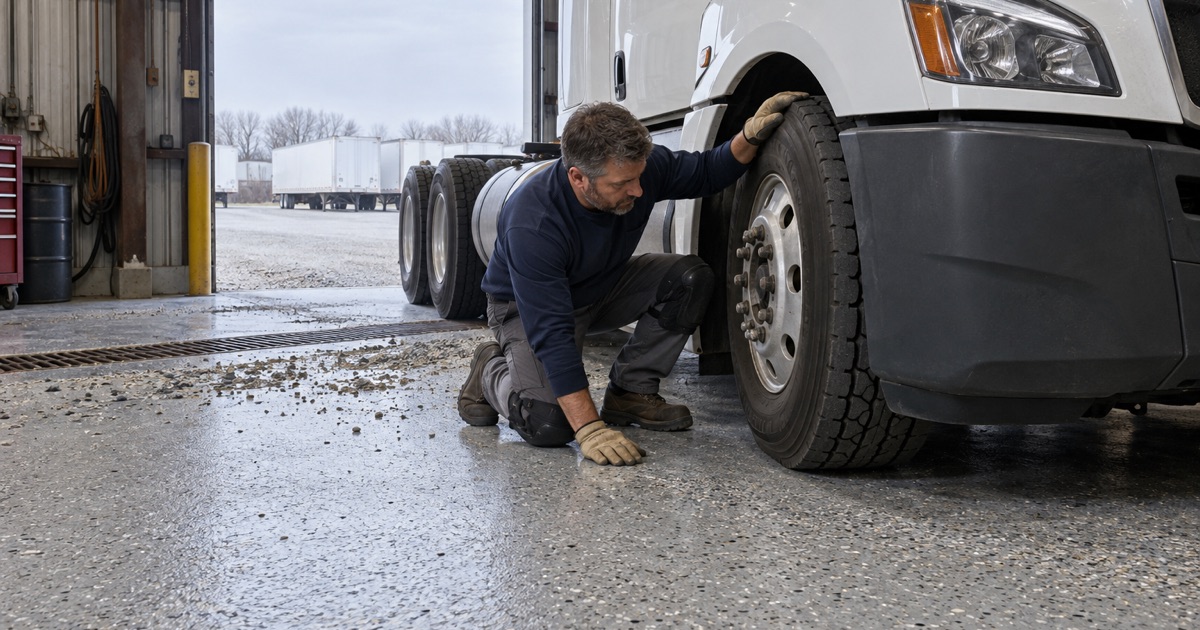
Truck tires with deep lugs pick up crushed stone and hold onto it. Shop owners describe trucks rolling in with stones packed in the treads and grit coating the tires, and that material does not stay put once the truck turns, brakes or sits on a jack. It drops onto the floor in the first few feet past the door and then gets driven over again and again.
A loose stone under a loaded tire behaves like a cutting tool. It is pressed into the surface, dragged as the wheel turns and released somewhere else, and the consequence our trade expects from that is gouging and scoring rather than gentle wear. A thin, glossy coating shows those marks first, and once the film is broken, the concrete underneath starts taking damage as well.
Fine Grit and Everyday Abrasion
The smaller fraction does its work more slowly. Dust and sand from a stone lot spread across the whole bay, carried by tires, boots, creepers and floor jacks, and every pass grinds at the surface like fine sandpaper. One shop owner reported that gravel-road traffic from a skid steer scratched and dulled his floor coating over the years until it needed attention.
That is abrasion in plain terms, and it is predictable. Traffic lanes from the doors to the lifts dull first, and the wear map of a gravel-fed shop usually reads like a diagram of where the trucks actually drive. Knowing that before we quote lets us put thickness and texture where the floor will be worked hardest instead of spreading material evenly across every square foot.
What the Door Line Tells Us
When we walk an existing shop, the first ten feet inside each overhead door tell us most of what we need to know. Chips, embedded stone, worn texture and lifted edges at the threshold show how much of the yard is reaching the floor, and whether an old coating failed from traffic or from poor bond. That reading drives the rest of the proposal.
Abrasion-Resistant, Aggregate-Textured Bay Floors
A bay floor fed from an unpaved yard is specified for abrasion and gouge resistance first and appearance second. In practice that points to two families of systems, both built thicker than a single-coat garage product, and both relying on surface preparation to deliver the life they promise. A 2026 shop-floor guide makes the same point in its own words: preparation governs how long a floor lasts.
High-Build Epoxy Under a Hard Topcoat
The first family uses 100% solids epoxy applied as a thick body coat, then sealed with a urethane or polyaspartic topcoat that takes the scuffing. Trade guidance holds that these multi-layer builds outlast single-coat systems on heavy-traffic floors, and industrial products such as PPG’s NU-KLAD SL are marketed for abrasion resistance under exactly that kind of use.
Thickness matters because a gouge has to cut through something before it reaches concrete. A thin film loses that race quickly, while a high-build body coat gives a stone something to scar without opening the slab. We write the finished thickness into the proposal so the shop owner knows exactly how much material stands between the tires and the concrete.
Broadcast Aggregate Systems
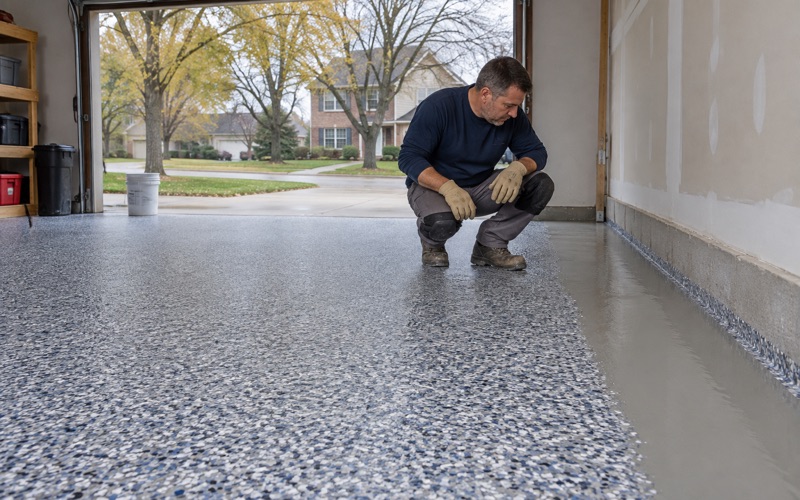
The second family adds texture. Quartz aggregate is broadcast into a wet epoxy coat to refusal, the excess is swept off, and the layer is locked in with further coats. The result is a floor with hard mineral grit through its thickness, which resists wear better than a smooth film and gives boots more grip when fluids and dust are on the surface.
Texture carries a tradeoff we discuss openly. A coarser broadcast holds up longer and grips better, but it is harder to squeegee clean and catches fine dust. Most truck bays land somewhere in the middle, with a heavier texture in drive lanes and door aprons and a finer one where mechanics kneel, roll creepers and clean up spills.
Joints and Cracks Before Any Coating
Heavy wheels find every weak edge. Before any system goes down we fill control joints with a semirigid filler so tires do not break the edges, and we repair the spalls and cracks we can stand behind. Where the slab itself is too damaged to carry a coating, we say so in writing rather than coating over a problem the trucks will simply reopen.
Grit Control at the Door, a Recoat Plan and a Weekend Window
No floor system is the whole answer in a gravel-fed shop. The cheapest wear is the wear that never reaches the floor, the most predictable maintenance is the kind planned on day one, and the hardest part of the job is often finding the hours to do it in a shop that keeps trucks moving all week long.
Stopping Stone at the Overhead Door
Grit control starts at the threshold. Heavy-duty entrance matting or a grate at each overhead door, a textured apron that sheds stone before the drive lane, and a routine of scrubbing the first stretch of floor each shift all reduce how much of the yard travels inside. Those steps cost little next to a recoat, and they stretch the life of whatever we install.
Cleaning practice matters too. Dry sweeping drags stone across the coating, so we recommend a scrubber or a wet method that lifts grit instead of pushing it around. Our own grinding dust and slurry are collected on site and never washed into a floor drain or storm sewer, and we suggest the shop handle its daily sweepings with the same care.
A Recoat Cycle Planned From the Start
On a floor that sees stone every day, the topcoat is a wear layer, and wear layers get replaced. The skid steer owner mentioned earlier restored his scratched floor after about 10 years with a light sanding and a thin recoat. That is the model we plan around: a scheduled scuff and fresh topcoat on the busiest lanes, done long before the body coat underneath is ever exposed.
Weekends as the Work Window
A shop approved to run 24 hours a day, Monday through Friday, leaves the weekend as its floor window, and that is how we schedule truck bays. Grinding, repairs and coats are sequenced from Friday night through Sunday, with curing timed against slab temperature and dew point rather than the clock. Larger shops can be phased bay by bay over several weekends so the trucks never stop.
- 20+ Years on Concrete
- Moisture Testing in Every Scope
- Written Contract Before Any Deposit