New Berlin Epoxy Flooring installs epoxy flooring in Mukwonago garages and basements with more than 20 years of slab work behind every quote. This page is written for one particular owner: the household keeping a small flock of backyard chickens. Chicks spend their first weeks in a warm brooder, and that brooder has to sit somewhere. Very often it sits on bare garage concrete, the hardest surface on the property to get truly clean.
Concrete looks solid, but it is porous. Fine dust, spilled feed, wet bedding and droppings work into the surface pores and hairline cracks, and a hose and broom only move the top layer around. A sealed, nonporous coating changes that. Debris sits on top of the floor rather than inside it, so it can be scraped up, washed off and disinfected before the car comes back in.
Below we walk through the village license that comes first, why spring chicks so often end up brooded in the garage, what public health guidance says about cleaning up after poultry, and how we build a garage floor meant to be washed down. None of it is a legal requirement to coat anything. It is the practical case for a floor that can be cleaned the way that guidance describes.
Backyard Chickens in Mukwonago Start With a Village License
Raising hens inside the village is allowed, but it is licensed, and the paperwork shows how seriously the Village of Mukwonago treats poultry kept next door to other families. The steps come before the first chick is bought, and they shape where a flock lives during its first season. Here is what the village lays out, and where many local chicks come from.
The license, the DATCP registration and the neighbors
The Village of Mukwonago backyard chicken license costs $40, with an annual renewal of $10. With the application, residents upload a premises registration from the Wisconsin Department of Agriculture, Trade and Consumer Protection. That DATCP registration is free, is renewed every three years, and supplies the Premises ID number and expiration date the village asks for. In other words, the state has the flock on record before the village issues anything.
The application also needs a plan or diagram that meets the village’s chicken ordinance, Ordinance No. 983, and approval from every owner whose property line abuts the proposed location. We have not read the ordinance itself, so we will not quote flock limits or coop rules here; the village office is the place to ask. What matters for the floor is simpler: the neighbors have signed off, and the flock is expected to be kept cleanly.
Chick Days at the farm store
Many local flocks start at the farm store. Tractor Supply runs its Chick Days promotion each spring, putting live baby chicks and ducklings in stores across the chain, and its Mukwonago store on South Rochester Street carries farm supplies and poultry feed. Whether that particular store has live birds in a given year is worth confirming with the store directly, since stocking is decided at the chain level.
However a household gets its chicks, they arrive small and unable to keep themselves warm. They go into a brooder, usually a tub or pen with a heat source, bedding, a feeder and a waterer, for their first weeks. That is when the cleanup question begins, because a brooder in daily use throws dust, scattered feed, wet shavings and droppings well beyond its own walls.
A feed store is an animal-contact venue too
The 2023 NASPHV compendium on animal contact in public settings lists feed stores among the venues it covers, and it treats temporary and seasonal exhibits as particularly vulnerable to design flaws. A spring chick display on a retail floor is exactly that kind of animal area, best kept on a surface that washes down, with bedding off the customer aisles. The same reasoning follows the chicks home.
Looking for epoxy-flooring closer to Menomonee Falls? See Menomonee Falls Epoxy-Flooring.
Why the Brooder Ends Up on the Attached Garage Floor
Ask where a brood of spring chicks spends its first weeks and, in much of the village, the answer is the garage. The reasons are practical rather than legal, because nothing in village code says where a brooder goes. But the housing here and the way health guidance treats poultry indoors both push the brooder toward the one room with a concrete floor and a door to the outside.
Attached garages are the village standard
In the village’s R-1 single-family district, the zoning code says that garages shall be attached. Census estimates count 2,433 of the village’s 3,331 occupied homes as owner-occupied, and 2,219 housing units as detached single-family houses. That adds up to a lot of attached garages, each sharing a wall and a service door with the living space, and each a likely home for a brooder in spring.
An attached garage is the obvious brooder spot. It is sheltered from wind and predators, it usually has an outlet for a heat lamp, and it keeps the birds out of the kitchen and family room. The tradeoff is that whatever the chicks kick out of the brooder lands a few steps from the door into the house, on a slab the family walks across every single day.
What a few weeks of chicks leave behind
Brooding is messy in a way that is easy to underestimate. Chicks scratch bedding over the sides, tip waterers, scatter feed and shed a steady fine dust of dander and dried droppings. On bare concrete the wet spills soak in and the dust settles into the surface texture, the joints and the cracks, where a broom does not reach. When the birds move out to the coop, that floor needs far more than a sweep.
Old garage slabs make it worse. A floor that has taken years of road salt and calcium chloride brine often has a rough, open surface with scaling, which gives droppings and dust even more places to hide. Efflorescence and a failing old coating add flaking edges that trap debris underneath. A worn slab is harder to clean after a brooding season than a sound one, not easier, and it rarely comes fully clean.
Keeping dust and bedding out of the house
The NASPHV compendium divides animal settings into animal, transition and nonanimal areas, and it advises against carrying manure and soiled bedding through nonanimal spaces. At home, the garage is the animal area during brooding season and the house is the nonanimal one. A garage floor that can be cleaned completely keeps that line from blurring every time someone walks in from the car with bedding on their shoes.
What CDC and the Animal-Contact Compendium Say About Cleanup
Two public health sources speak directly to backyard poultry and the surfaces around them. Neither requires a coated garage floor, and we would never sell one as if it did. But both describe a cleanup routine that bare concrete makes difficult and a sealed surface makes ordinary, and that is the honest case for coating a garage that has brooded chicks or will next spring.
CDC: keep poultry out of the house
The CDC backyard poultry guidance is direct: don’t let backyard poultry inside the house, especially where food or drinks are prepared, served or stored. It also says to go outside to clean any equipment or materials used to raise or care for live poultry. And it warns that poultry can appear healthy and clean but still spread harmful germs that make people sick.
Put those together and the garage becomes the working room for the flock’s early weeks. The brooder, feeders and waterers live there, and they get scrubbed outside or just past the open overhead door. That makes the garage floor the surface carrying most of the flock’s spillover, and if it cannot be cleaned and disinfected, the routine the guidance asks for stops halfway through.
NASPHV: floors that are hard to clean and disinfect
The compendium recommends that, where feasible, the animal area, flooring and railings included, be cleaned and disinfected as necessary. It singles out floors and other surfaces that are difficult to keep clean and disinfect as a common problem in animal settings. Written for public venues, the point carries straight into a home garage: a disinfectant only works on the surface it can actually reach.
Children under 5 and dedicated shoes
Both CDC and the compendium say children under 5 should not have direct contact with live poultry, chicks included. CDC also advises dedicated shoes for poultry chores, kept outdoors. In a family garage that means the brooder corner gets fenced off from small kids, chore boots stay out by the coop, and the floor everyone else crosses should be one that washes down easily and completely.
A Floor You Can Scrape, Wash and Disinfect
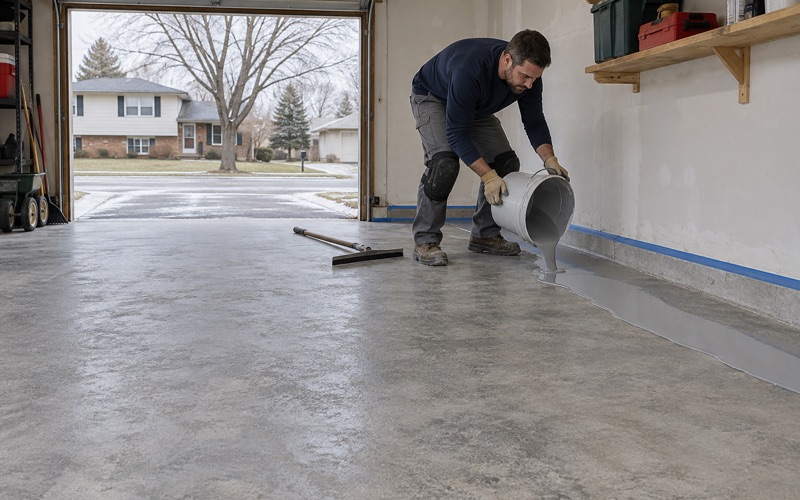
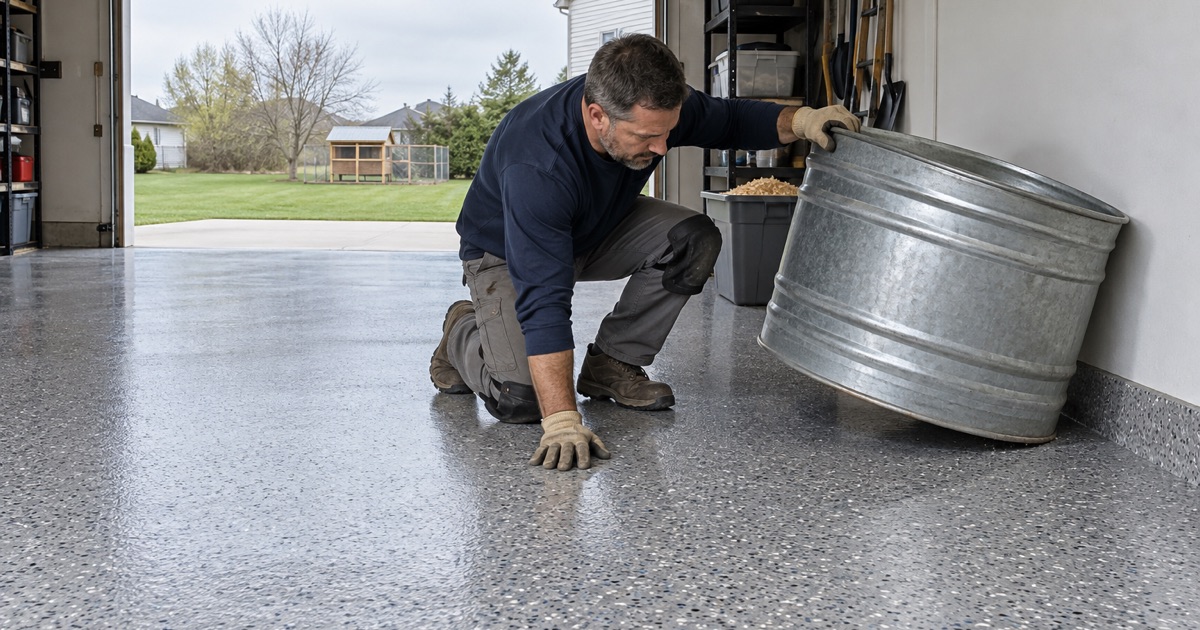
A coated garage floor will not make a flock germ-free, and no coating is a guarantee against illness. What it does is turn a porous slab into a sealed, continuous surface. Droppings and bedding sit on top, a plastic scraper lifts them, and a wash and disinfectant reach the whole floor rather than only the high spots. Here is how we build one for a garage that doubles as a brooder room.
Opening the slab and testing for moisture first
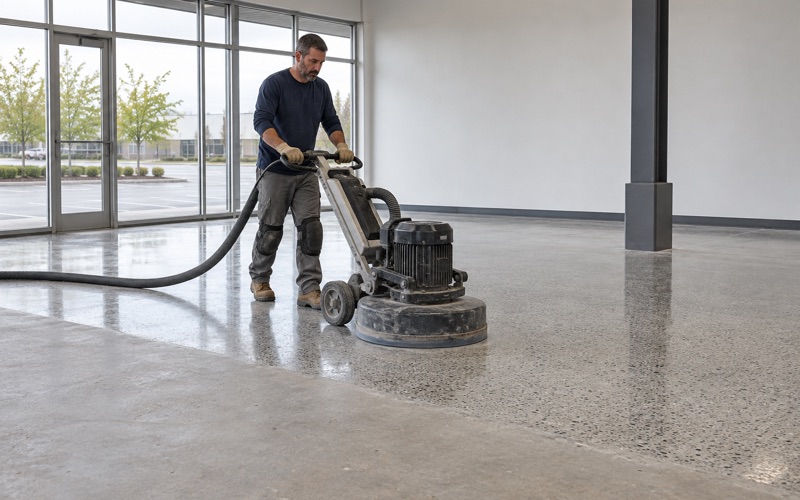
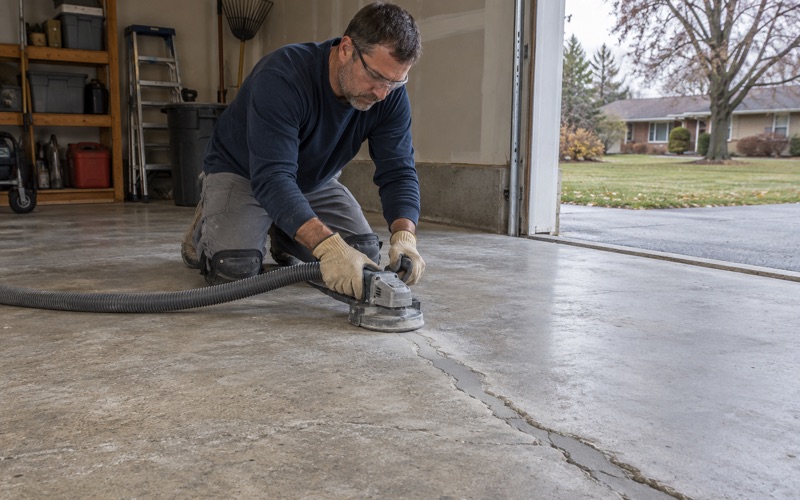
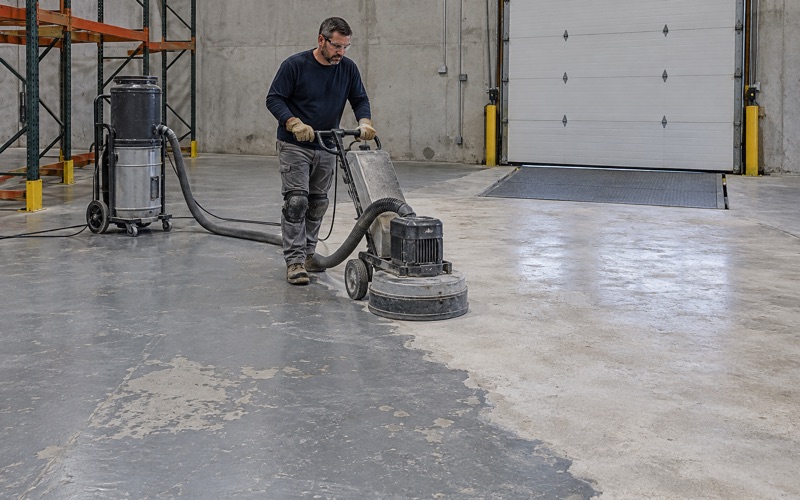
Every slab is opened with a diamond grinder or shot blaster to a proper ICRI concrete surface profile, and we never acid etch. Before quoting we read the cracks, joints and any old coating, and we say plainly if the slab needs repair or replacement first. Moisture testing is in the scope from day one, using ASTM F1869 calcium chloride kits or ASTM F2170 in-situ relative humidity probes.
That testing matters on attached garages because the Wisconsin Uniform Dwelling Code does not require a vapor retarder under an unconditioned attached garage slab. A floor that looks dry can still push moisture up from below, and moisture is the first exclusion we read out of any warranty before the job is sold. Grinding dust and slurry are collected on site, never rinsed into a floor drain or storm sewer.
Building the coating for washdown
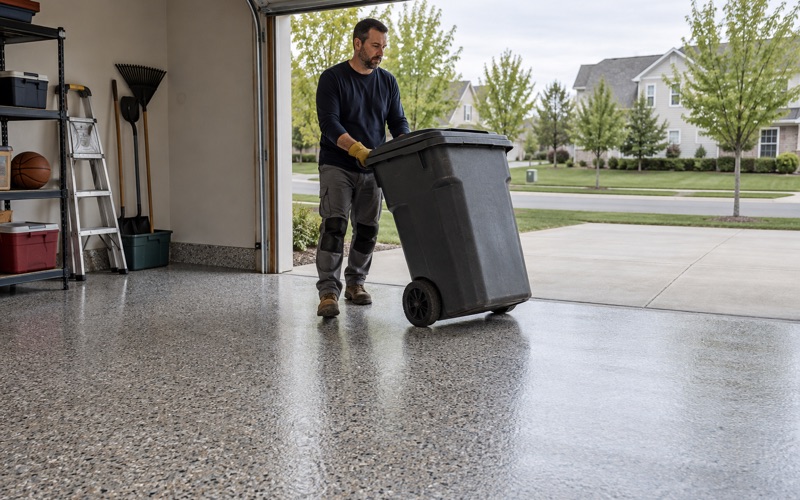
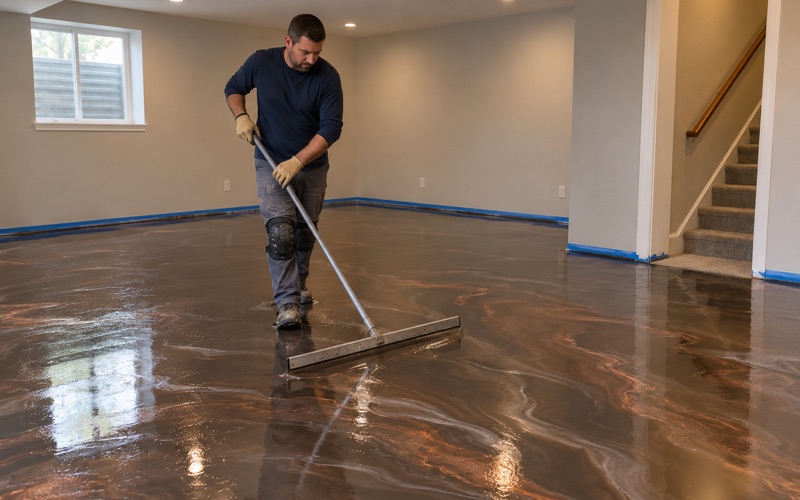
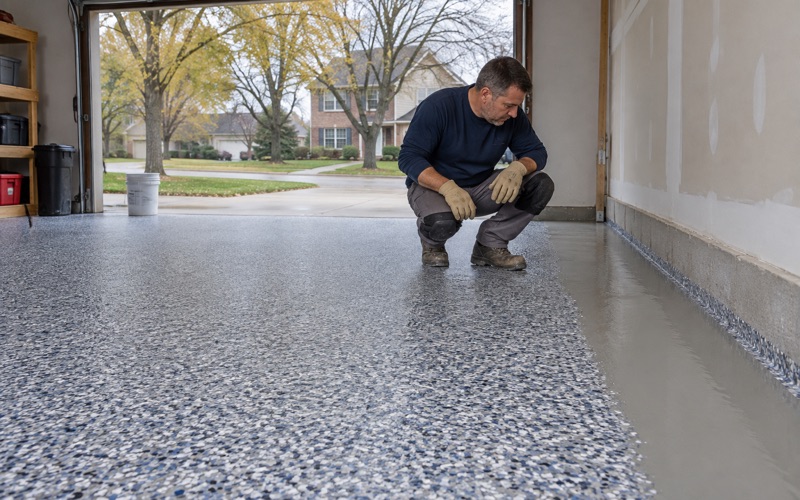
For a garage that will see bedding, feed and frequent washing, we favor a 100% solids epoxy base with a vinyl flake or quartz aggregate broadcast, finished with a polyaspartic or polyurea topcoat. The broadcast adds texture and hides wear, and the topcoat closes the surface so water and disinfectant sit on it instead of soaking in. The proposal names the product, the system build and the finished thickness.
A coved edge where the slab meets the wall is worth considering in the brooder corner, since bedding collects in that seam. The same topcoat stands up to the road salt and calcium chloride brine a Wisconsin winter tracks in on the tires. Cleanup then becomes routine: scrape, sweep, wash with a mild detergent, apply a disinfectant, rinse and let the floor dry before parking again.
Timing the job around chick season
Curing is scheduled against slab temperature and the dew point spread at the surface rather than the calendar, and an unheated garage sometimes has to wait for warmer weather. For a flock household, the best window is usually after the chicks have moved out to the coop, once the slab has had a full cleanup. Every home job gets a written contract before any deposit, with the products and warranty spelled out.
- 20+ Years on Concrete
- Moisture Testing in Every Scope
- Written Contract Before Any Deposit