New Berlin Epoxy Flooring brings more than 20 years of epoxy-flooring work to Menomonee Falls, and the shop floors we find hardest to get right are the ones worn down by grit rather than eaten by chemicals. A hard particle trapped under a cart wheel or a boot heel acts like sandpaper on a coating. Repeat that thousands of times a shift, and a finish chosen for looks turns dull and thin within a season.
That is why we start every industrial quote by asking what lands on the floor, how often, and how it leaves. Some shops shed metal chips, some drip fluids, and some scatter fine mineral grit that behaves differently from both. The answer decides the surface profile we grind to, the system we build, the aggregate we broadcast and the topcoat we finish with, and each of those goes into the written proposal.
This page walks through one of the toughest grit cases in the trade: the floor around an abrasive waterjet. We cover where the abrasive comes from, how it escapes the machine, how it gets dug back out, and the floor that holds up through all of it. The figures we quote are typical of the waterjet trade, drawn from published shop guidance, rather than measurements taken from any one Menomonee Falls shop.
An Abrasive Waterjet on Technology Drive
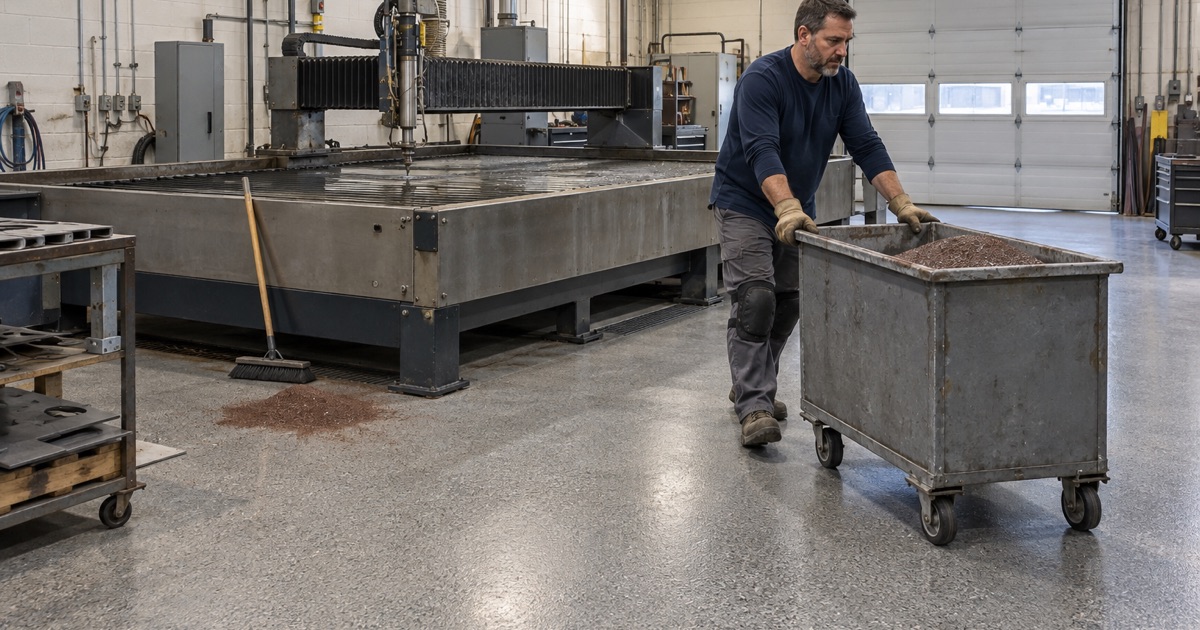
Reich Tool & Design, at W175 N5750 Technology Drive in the village, lists waterjet cutting on an OMAX 80X among its services. The machine runs at 60,000 psi over a 20-by-6.5-foot cutting area and takes material up to 6 inches thick, cutting metal, plastic, foam, rubber, gaskets and stone. The OMAX 80X is an abrasive waterjet, and that one detail tells us what the floor around a table like it has to survive.
A Pound of Garnet a Minute
An abrasive waterjet does not cut with water alone. Garnet is pulled into the stream and propelled at more than Mach 3, and the grit does the cutting. Published guidance for fabricators puts typical abrasive feed at 0.75 to 2.4 pounds a minute, with a working rule of thumb of about a pound a minute while the jet is cutting, so the abrasive supply is never a small matter.
Reich’s own page does not name its abrasive or its usage, so we are not putting a number on their machine. What the general figure gives any shop owner is a sense of scale. Abrasive arrives in 55-pound bags or in bulk bags of 2,200 to 4,400 pounds, and an hour of steady cutting at that rule of thumb moves more than a full small bag through the nozzle and into the tank.
Harder Than Most of What It Touches
Almandine garnet, the mineral that dominates waterjet cutting, rates 7.5 to 8 on the Mohs scale and has a specific gravity of 4.1. That makes it harder than the quartz sand found in most concrete and far harder than a cured resin film. When a grain rolls under a pallet jack wheel, the coating is the softer surface in the contact, and the coating is what gives way.
Weight matters as much as hardness. With a specific gravity of 4.1, garnet is dense enough to settle quickly and stay where it falls, packing into texture, joints and low spots instead of drifting off. A floor that collects it in its grooves tends to wear from the grooves outward, so the shape of the surface becomes part of the abrasion question, not just the hardness of the topcoat.
Reading the Machine, Not the Shop
We are careful about what a public equipment listing does and does not tell us. It confirms the machine, the pressure and the table size, and it says nothing about Reich’s floor, its cleanout method or its housekeeping. What follows is the trade practice that applies to any abrasive waterjet, which is exactly how we approach a waterjet bay in Menomonee Falls that we have not yet walked in person.
Looking for epoxy-flooring closer to St. Francis? See Epoxy-Flooring in St. Francis.
Spills, Splash and Grit on the Boots
Garnet that ends up in the tank is spent abrasive doing its job. The floor deals with everything else: what misses the hopper, what rides out on spray, and what leaves the machine area on people and equipment. Each of those routes puts grit in a different place, so we map them with the shop before we decide where texture goes and where a smoother surface serves better.
At the Hopper and Pressure Pot
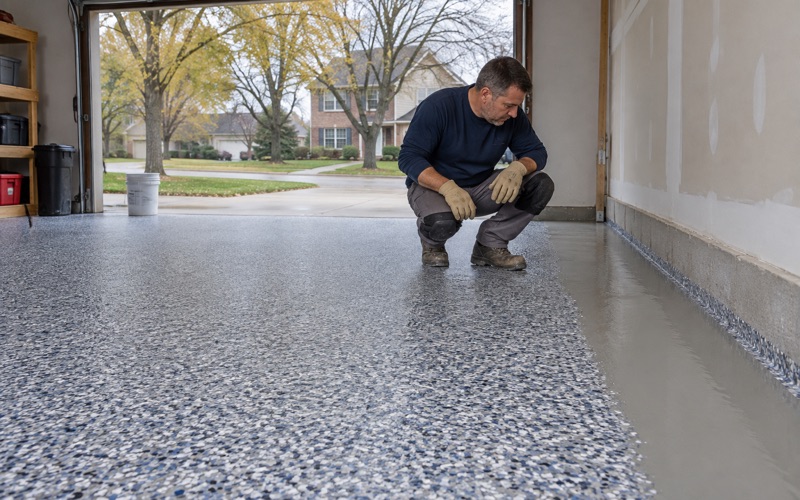
Every bag poured into a hopper and every refill of a pressure pot risks a spill. Grit that lands there sits beside the machine, where operators stand, kneel and set down tools, which makes it one of the most heavily used patches in the bay. We build that zone thickest, usually a 100% solids epoxy body with a quartz aggregate broadcast locked in under a hard topcoat.
Published guidance says spilled garnet should not be swept up and reused for cutting, so it goes in the trash, and the floor near the hopper gets swept often and hard. A surface with deep, sharp texture holds grit in its valleys and fights the broom. We tune the broadcast size and the topcoat for grip without leaving pockets that trap loose abrasive between sweeps.
Splash When the Jet Pierces
When a waterjet pierces the material, it sprays water beyond the table. That water carries fine garnet with it, so the strip around the table edge is wet and gritty at once, the worst pairing for both slip and wear. A smooth, glossy coating there turns slick, and a soft one wears through along the path operators walk to load plate and unload parts.
We give the splash strip a slip-resistant texture and a hard topcoat, often a polyaspartic or polyurea finish over the broadcast. Where the slab around the table also sees standing water and frequent washdown, urethane cement is worth pricing, since it tolerates moisture and temperature swings better than a thin film. Either way, the proposal names the product, the build and the finished thickness so it can be checked afterward.
Tracked Off on Boots and Carts
Grit that leaves the bay on boots and cart wheels becomes everyone else’s problem, scratching aisles and break areas that were never built for abrasion. Joints suffer first, because garnet packs into an open saw cut and a wheel then chips the edge. We fill plant joints with a semirigid filler before coating, and we often carry the textured system a few feet past the splash line as a walk-off.
Digging Out the Tank: Shovels, Small Excavators, Vacuum Trucks
Spent abrasive collects in the catch tank under the slats until it rises close enough to need removal. Some machines pump it out through an integrated system, but many shops still clear it by hand or with equipment. The published manual options are a shovel, a small excavator, or a vacuum truck service, and each one puts a different load on the floor between the tank and the door.
Shovels, Buckets and Wheelbarrows
Manual cleanout means wet, heavy, spent garnet carried or wheeled across the floor, with drips and spillage along the whole route. A loaded wheelbarrow concentrates its weight on a narrow tire, and any grit under that tire grinds the surface. We treat the cleanout path as a traffic lane and give it the same abrasion-resistant build and texture as the splash strip around the table.
Wet abrasive also leaves a film behind as it dries, which can read as a dull haze on a coated floor and hide the next spill. A lighter-colored finish helps here, because a clean sweep is easy to confirm and a missed patch stands out. We talk through color with shop owners as a housekeeping decision, not just a look, before any materials are ordered for the job.
Small Excavators at the Tank
When a shop brings a small excavator to the tank, the floor sees tracks, a machine turning in place, and a bucket dropping wet abrasive. Track pivots scuff hard, and a thin coating will peel at the turn. We ask about the machine and its tracks before quoting, then plan the route so the turning happens on the thickest, best-bonded part of the system rather than on a thin seal coat.
Vacuum Trucks and Extraction Wands
A vacuum truck service works from outside, running a hose from the truck through a door to the tank. Portable extraction wands are another option, and one published figure puts them at up to 3,000 pounds of spent abrasive an hour. The hose route needs to stay open, which means no racks, carts or bagged garnet parked between the tank and the overhead door.
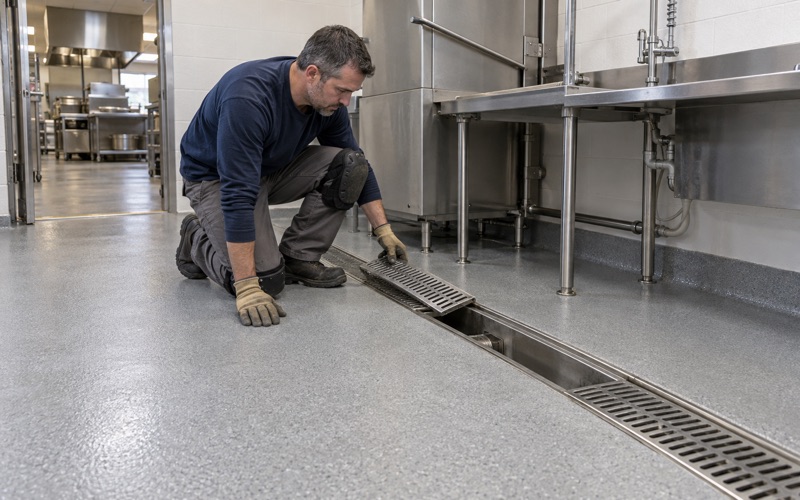
Hoses drag, and a wet hose pulling grit across a floor is a long, slow scouring pass. Along that route we favor a hard topcoat and flush transitions with no raised lips, so the hose slides rather than catches. We also look closely at the door threshold, since a chipped coating edge at the door is usually where the next repair starts on a waterjet bay floor.
Abrasion-Resistant, Sweepable Floors Around the Table
Put the pieces together and a waterjet bay floor has three jobs. It has to resist abrasion from a mineral harder than quartz, carry enough texture to stay safe when wet, and sweep clean enough that spilled garnet goes into the trash rather than into the grooves. No code we know of calls for a particular finish around a waterjet, so the choice rests on practice and on the shop’s routine.
Preparation and Build
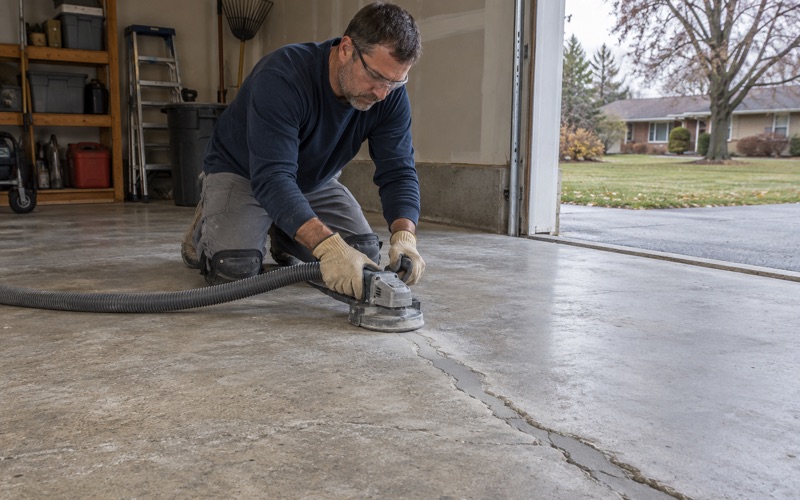
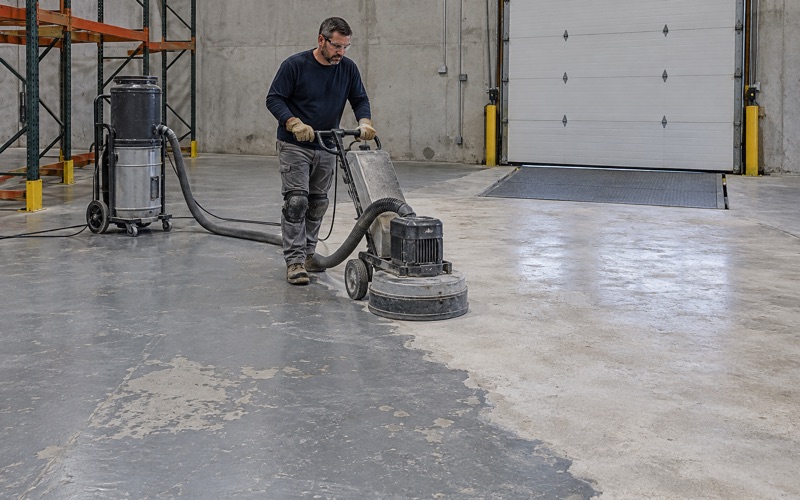
Every slab we coat is opened first with a diamond grinder or shot blaster, never acid etched, to a surface profile matched to the system’s thickness. A heavy broadcast system needs a deeper profile than a thin seal coat does. We read the cracks, joints and any old coating before we quote, and if a slab needs repair before it can carry a coating, we say so plainly.
For the build itself, 100% solids epoxy with a quartz aggregate broadcast and a polyaspartic or polyurea topcoat gives us thickness and hardness together. We test moisture with ASTM F1869 or ASTM F2170 before coating, because vapor rising through the slab can lift even a thick system. Curing is then timed to slab temperature and the dew point spread at the surface, not to the calendar.
Texture That Sweeps Clean
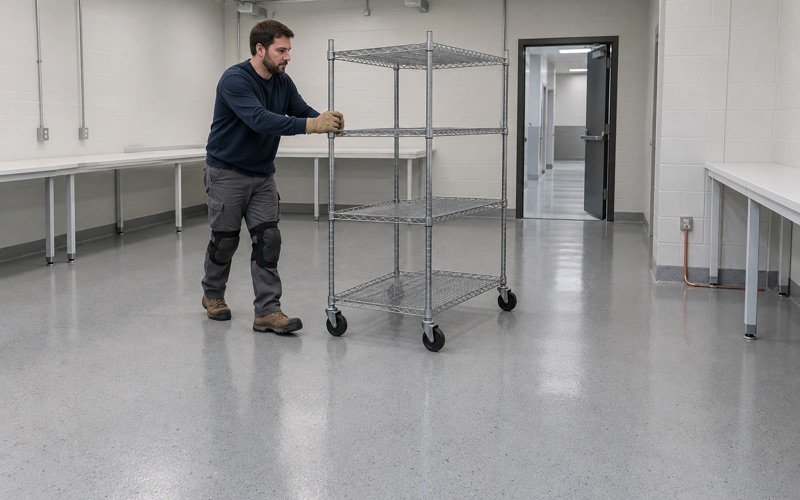
The finish we aim for has enough grit for wet boots without deep pockets for loose garnet. We control that through the size of the quartz broadcast and the number of topcoats over it, rounding the peaks so a push broom slides across. A sample board set in the bay, wetted and swept with a handful of the shop’s own grit, settles the choice faster than any spec sheet.
Dry Storage, Permits and Production Windows
Bagged garnet belongs indoors, dry and away from the waterjet, so a storage area outside the splash zone should be part of the floor plan. We give it a smooth, sealed surface that is easy to sweep, separate from the textured bay. Grinding dust and slurry from our own preparation are collected on site and never washed into a floor drain or a storm sewer.
Menomonee Falls, a Waukesha County village and the most populous village in Wisconsin, runs its own Building Inspection Division. The village holds DSPS Appointed Agent status for building and HVAC plan review, so some commercial plans go to the village and others go to DSPS, and we ask which applies before scheduling. The work itself is planned around production, using weekends, shift breaks or a shutdown week.
- 20+ Years on Concrete
- Moisture Testing in Every Scope
- Written Contract Before Any Deposit