
New Berlin Epoxy Flooring installs ESD flooring in New Berlin, WI, serving surrounding cities including Hales Corners, West Allis, Greenfield, Brookfield and Waukesha. With more than 20 years on concrete, we approach ESD floors as precision work: a static-control floor that does not measure in range is just an expensive coating, so preparation, grounding and testing get as much attention as the resin itself.
Electrostatic discharge can damage or weaken electronic components long before anyone sees a spark. In electronics assembly, automation and controls work, data rooms and labs, the floor is part of the static-control program, working with grounded footwear, workstations and procedures to carry charge safely to ground.
We install static-dissipative and conductive epoxy and urethane systems with copper grounding, then test and document the readings at completion. Your proposal names the product, the system build, the target resistance range and the grounding layout, so the finished floor can be checked against the specification.
How ESD Floors Work
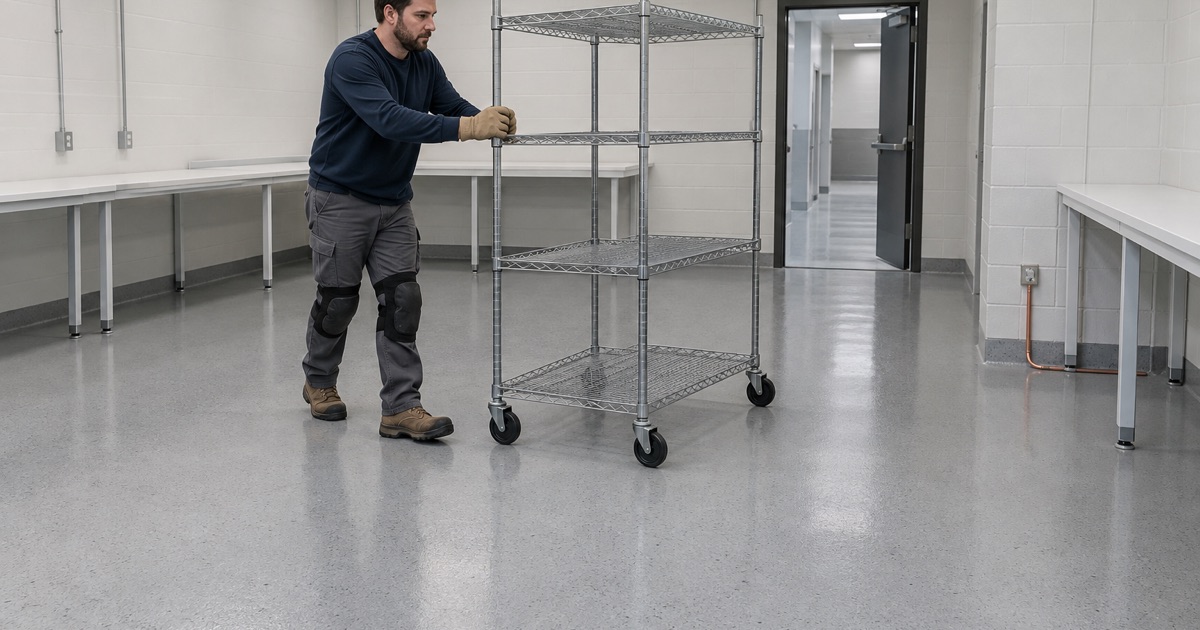
Conductive and Static-Dissipative Systems
ESD floors contain conductive materials, such as carbon fibers or conductive fillers, that give the coating a controlled electrical resistance. Under the ESD Association’s floor test method, ANSI/ESD STM7.1, conductive flooring measures at or below 1.0 x 10^6 ohms, and static-dissipative flooring sits above that range. Both bleed charge to ground; they differ in how quickly.
The right choice depends on what is being handled, the footwear program and the specification your facility works to. We follow the range in your specification rather than choosing one by habit.
Floor and Footwear as One System
The electronics industry’s control program standard, ANSI/ESD S20.20, treats the floor and footwear as a single grounding path. It measures the resistance of a person wearing their footwear while standing on the floor, which must be less than 1.0 x 10^9 ohms, and it limits the voltage a person generates while walking to less than 100 volts. A great floor with the wrong shoes can still fail that test.
That is why we ask about your footwear and heel-grounder program early. The floor we specify should work with the footwear your staff actually wear.
Grounding the Floor
An ESD floor is only as good as its connection to ground. We lay copper grounding strips under the conductive primer at intervals set by the manufacturer and connect them to building ground points. The layout is planned around the room so every area of the floor has a short path to ground.
We coordinate the connection points with your electrician or facilities team before the floor goes down. Moving a ground point after the coating is finished means cutting into a floor that was tested as a whole.
Epoxy and Urethane ESD Systems
ESD floors come in several resin types. Static-dissipative epoxy gives a hard, chemical-resistant surface for assembly and test areas, while urethane-based systems offer more flexibility and comfort underfoot where people stand for long shifts. Both are seamless and easy to clean, and both depend on the same careful grounding and testing.
Where ESD Floors Are Used
Electronics Assembly and Repair
Circuit board assembly, electronics repair and testing areas handle sensitive components in the open, where a discharge from a person or cart can cause damage. Static-dissipative flooring is a common choice in these areas, combined with grounded workstations and footwear.
Automation, Controls and Robotics
Control panels, drives and automation equipment are built and serviced in many local plants. Assembly benches and service areas for that equipment benefit from static-control flooring, especially where technicians handle exposed boards. In large plants, ESD zones are often only part of the floor, with tougher industrial systems elsewhere.
Data Rooms, Labs and Clean Areas
Server rooms, testing labs and clean areas use ESD floors to protect equipment and keep static from attracting dust. Some of these spaces also need chemical resistance or a smooth, easily cleaned surface, which the resin system can provide alongside its electrical properties.
Preparation and Installation
Slab Preparation
We open the slab with diamond grinding or shot blasting to the profile the system requires, remove old coatings that could insulate the floor, and repair cracks and joints. In working plants, joints are filled with a semirigid joint filler so carts and forklifts do not chip the edges. We never acid etch.
Grinding dust is collected at the machine and slurry is bagged on site, never washed into a floor drain. In clean and sensitive areas, that dust control matters as much as the finished floor.
Moisture and Cure Conditions
We test slab moisture with calcium chloride testing to ASTM F1869 or relative humidity probes to ASTM F2170 before installing. Moisture problems can affect both bond and electrical performance. During installation we monitor slab temperature and the dew point spread so each coat cures properly, because a poorly cured conductive layer can read out of range.
Testing and Documentation
After the floor cures, we test resistance to ground at points across the floor and document the results. Those readings give you a baseline for your own periodic testing. If an area reads out of range, we find out why before we hand the floor over.
Scheduling and Upkeep
Working Around Production
ESD areas are often inside active plants, including buildings in the New Berlin Industrial Park. We schedule work around shift breaks, weekends and shutdown weeks and phase the floor so production continues elsewhere. Each zone is returned to service on an agreed date.
Keeping the Floor in Range
ESD floors need the right cleaners. Waxes, polishes and some general-purpose floor cleaners leave insulating films that push readings out of range over time. We provide care instructions with each floor and recommend periodic testing as part of your static-control program.
- 20+ Years on Concrete
- Moisture Testing in Every Scope
- Written Contract Before Any Deposit