New Berlin Epoxy Flooring brings more than 20 years of experience to epoxy flooring in Elkhorn, and some of our most carefully planned jobs there start with an empty storefront. A commercial floor in an older downtown building is rarely just a coating job. It usually sits inside a larger plan to get a space leased, with paperwork, timing and a budget that all have to line up before anyone picks up a grinder.
That order of operations is what this page is about. We walk owners through how we scope a storefront floor, what we put in writing, and why the sequence matters as much as the resin. The goal is a slab that is repaired where it needs repair, coated with a system we name in the proposal, and built to last well past the day a tenant opens the doors.
We never acid etch a slab, and we never treat a dry-looking floor as a dry one. Every surface is opened mechanically, tested for moisture, and examined for cracks, joints and old coatings before we put a price on it. When a slab needs repair or replacement first, we say so in plain language rather than coating over the problem and hoping it holds.
Elkhorn’s Downtown Building Improvement Grant
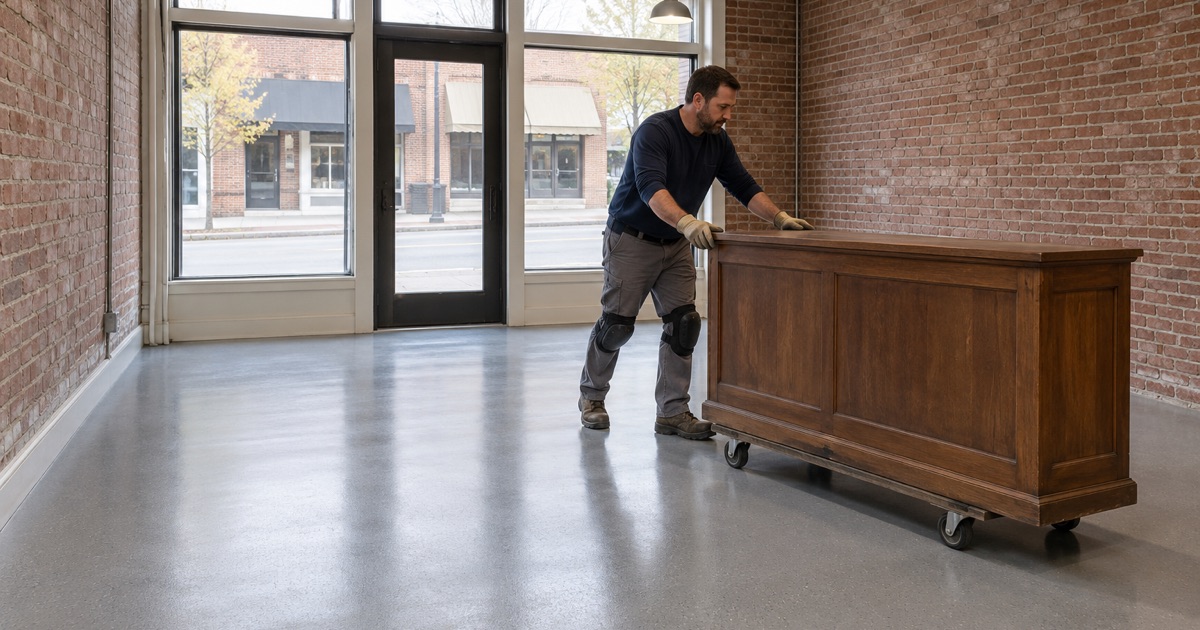
Downtown Elkhorn has a Building Improvement Grant run by the Elkhorn Economic Development Alliance together with the City of Elkhorn. Its stated purpose is to help commercial and retail owners and their tenants with building improvements that promote commercial use, create jobs and reduce the number of vacant buildings downtown. For anyone readying a storefront, it is worth understanding before a single bid is requested.
Not Just Facades
Plenty of downtown programs stop at the storefront glass. The Elkhorn program is designed to restore the structural integrity, longevity and commercial viability of properties located exclusively within downtown Elkhorn. Its eligible list includes improvements necessary for successful commercial use of the building and maintaining the integrity of the structure, alongside plumbing, electrical, HVAC, lighting, ADA accessibility work and facade projects.
The list does not name interior floors, and we will not tell you a coated slab qualifies. Whether a particular floor fits the program is settled in the required pre-application consultation, not by a contractor. What we can do is describe the floor work clearly enough that the people making that call understand exactly what is being proposed and why the building needs it.
How Awards Are Sized
Applicants in the Downtown Central Business District are eligible for 25 percent of total project cost, with a maximum award of $25,000. In the Community Mixed Use District the figure is 20 percent, up to $20,000. A property can be awarded once every five years, so owners planning several phases of work should think hard about which improvements belong in the one application.
We do not promise any amount, because the award depends on the district, the scoring and the reviewers’ decision. Scoring favors properties vacant over 24 months, secured tenants, job creation and project scale. Elkhorn awarded $60,000 in downtown building grants during 2025, which shows the program is active, though no single project’s share can be predicted in advance.
Where Applications Go
Applications are filed in person at the Elkhorn Area Chamber of Commerce and Tourism Center at 203 E Walworth St. They are due the first Thursday of the month and reviewed the second Thursday. We plan our own proposal dates backward from that deadline, so a tenant’s move-in date never rests on an assumption that nobody checked.
Looking for epoxy-flooring closer to Hales Corners? See Epoxy-Flooring in Hales Corners.
Consult, Bid Twice, Get Approval, Then Start
The program’s rules impose a sequence, and a floor job planned outside it can lose its eligibility entirely. Work must be approved by the EEDA and City of Elkhorn officials prior to construction beginning, and any work already commenced is not eligible. That means our grinder stays on the trailer until the approval is in hand, however eager everyone is to get moving.
The Pre-Application Consultation
Before applying, an owner must consult with the EEDA and the city Zoning Administrator or Building Inspector. Elkhorn contracts its building inspection, and the Building Inspector keeps office hours from 1:00 to 4:00 p.m. on Monday and Wednesday at the City Administration Offices. A commercial building falls under the state commercial building code rather than the dwelling code, so permit questions belong in that same conversation.
We are glad to supply what that meeting needs: a description of the slab’s condition, the repairs we found, and the system we would install. Bringing a written scope rather than a vague intention makes it easier for the city and the EEDA to judge whether the floor serves the building’s commercial use. It also surfaces any permit question before a date is set.
Two Written Vendor Bids
The application requires a minimum of two vendor bids. Ours names the product, the system build and the finished thickness, so a reviewer can compare it line by line with the second bid instead of weighing two vague totals. If one contractor quotes a thin roll-on coat and the other a ground, primed and broadcast system, the paperwork should show that difference plainly.
A detailed bid also protects the owner after the award. When the proposal states the exact system, what goes down on the slab can be checked against what was approved. We also read the warranty exclusions aloud before anything is signed, naming moisture from below first, so the owner knows precisely what the warranty does not cover.
Approval, Then Grinding
Once the EEDA and the city approve the application, the clock starts, because approved work is to be completed within 12 months. We schedule the grind, repairs, coating and cure inside that window, and on an occupied block we plan around neighbors and street-level access. Grinding dust and slurry are collected on site and never washed into a floor drain or storm sewer.
A Floor That Is Part of the Building
The program draws a firm line between the building and what goes inside it. Furnishings, equipment and other personal property are ineligible, as are expansion, new construction and general site work. A floor contractor’s job is to make sure the proposed work is described on the building side of that line, and that distinction shapes how we write every storefront scope.
Slab Repair Versus Removable Finishes
Loose mats, carpet tiles and floating products a tenant can carry out the door look a lot like furnishings. A slab that is ground, repaired and coated is bonded to the structure itself, so we frame storefront work around the concrete: crack repair, joint treatment and a coating system keyed into the surface. None of that framing guarantees eligibility, and the final word on any floor belongs to the EEDA and the city.
Readying a Vacant Space for a Tenant
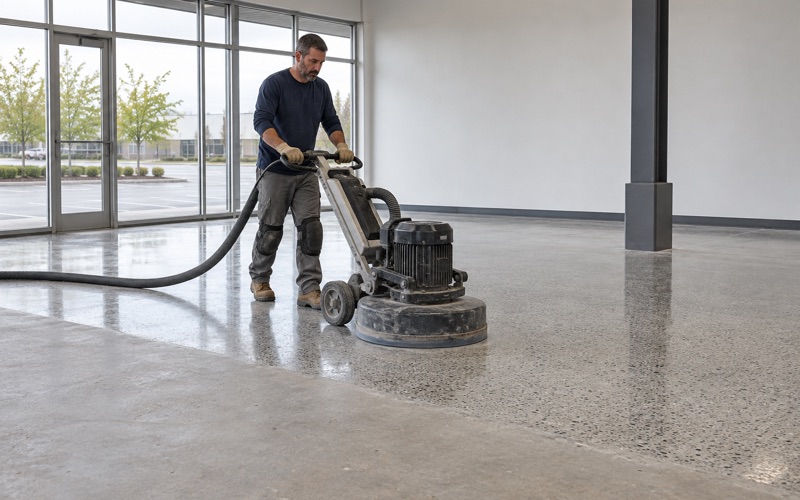
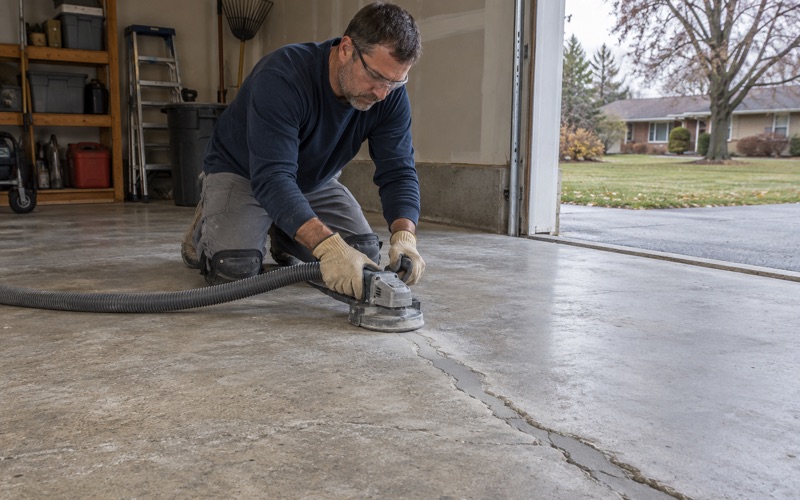
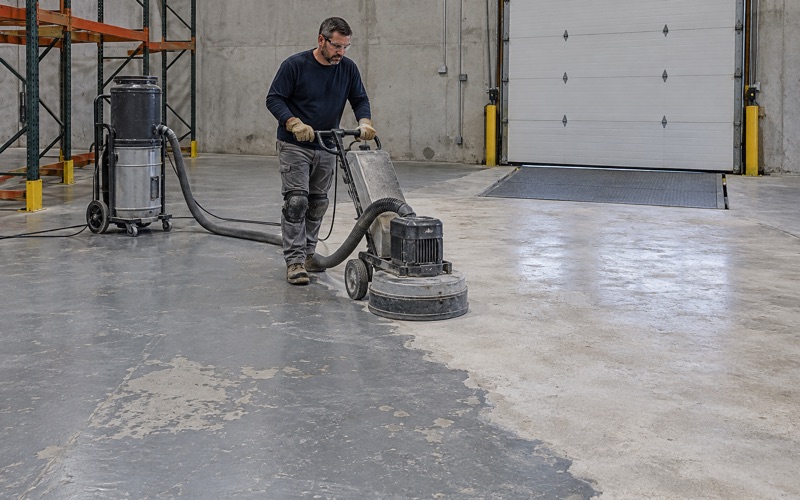
A storefront that has sat empty often hides old adhesive, tile residue, patched trenches from past plumbing work and cracks that need reading before anything is quoted. Removing those layers is part of what makes the space usable for commercial occupancy again. We use diamond grinding or shot blasting to reach the ICRI CSP profile the chosen system calls for, because a coating bonds only as well as the surface beneath it.
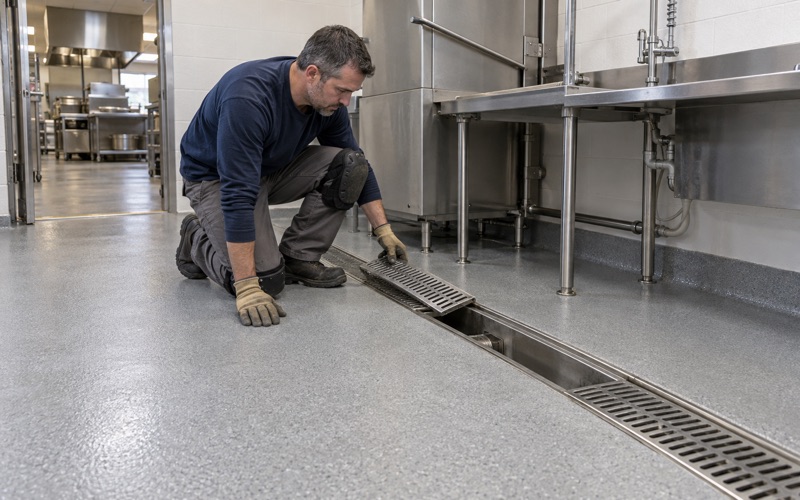
The intended tenant shapes the finish. A retail space may want a decorative vinyl flake broadcast, while a food tenant falls under the Wisconsin Food Code, with licensing and inspection coming from the state rather than the county, and needs a coved base where floor meets wall. Settling the future use before bidding keeps the system from being chosen twice.
What We Read Before Quoting
Before pricing, we look at every crack, every control joint and any coating already on the slab. Some cracks are cosmetic, some move, and some signal a slab that needs repair or replacement before it can carry a coating at all. Joints that will see cart traffic get a semirigid filler before coating so the edges do not break down.
Moisture testing is written into the scope rather than sold later. Depending on the slab we use ASTM F2170 in-situ relative humidity probes, ASTM F1869 calcium chloride tests, or an ASTM D4263 plastic sheet test as a first look. The results decide whether a moisture-mitigation primer belongs under the system, and they become part of the record we hand the owner.
Five Years Without Alteration
The grantee must maintain the completed improvements for a period of five years without alteration unless the EEDA approves otherwise in writing. For a floor, that condition changes the product conversation. A coating that will need grinding off and redoing in three years is a poor match for a commitment that runs five, whatever its price looks like on the bid sheet.
Choosing a System That Holds Up
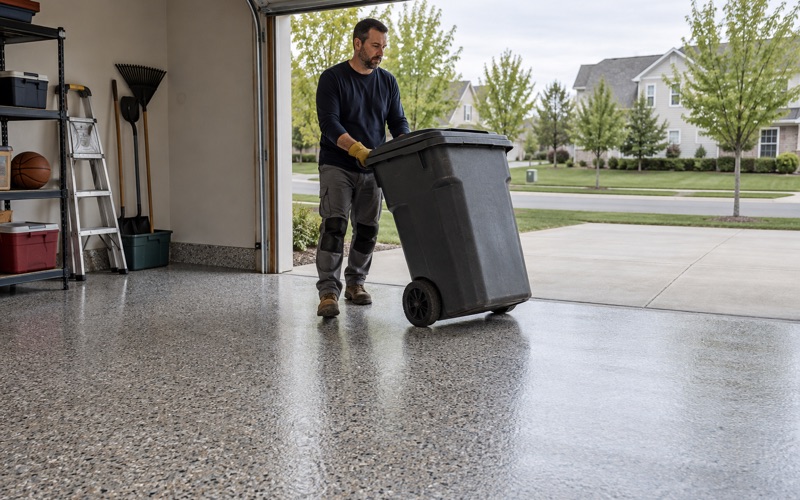
For storefront traffic we usually build on 100% solids epoxy over a properly profiled slab, finished with a polyaspartic or polyurea topcoat for abrasion resistance and color stability near windows. Quartz aggregate broadcast adds texture and wear depth where foot traffic is heavy. The proposal states the finished thickness, because thickness is a large part of how long a floor lasts.
Where a tenant expects water, grease or hot cleaning, urethane cement is often the stronger choice. It tolerates thermal shock and wet conditions that a standard epoxy build does not. We explain the tradeoffs in cost, cure time and appearance so the owner can pick a system that will still be in good shape when the five-year term ends.
Winter Salt at the Front Door
Downtown entrances take whatever comes in on boots, including rock salt and calcium chloride deicer. Those salts leave a white film and can attack a weak finish near the door. A broadcast texture and a chemical-resistant topcoat at the entry hold up to that seasonal cycle far better than a thin coat, and we leave written cleaning guidance so a tenant never reaches for a stripper that would alter the floor.
Curing and Scheduling
Curing is scheduled against slab temperature and the dew point spread at the slab surface rather than the calendar. A storefront left unheated while vacant may need heat restored before coating, or amine blush and poor adhesion become real risks. We plan that inside the 12-month completion window so the schedule never forces a coat onto a cold slab.
We also watch for outgassing and pinholes on older concrete, which can push air up through a fresh coat as the slab warms. A primer coat applied while the slab temperature is falling reduces that risk. The aim is one installation done correctly, so the floor the reviewers approved is the floor still in place five years later.
- 20+ Years on Concrete
- Moisture Testing in Every Scope
- Written Contract Before Any Deposit