New Berlin Epoxy Flooring has spent more than 20 years on epoxy flooring in Downtown Milwaukee and across the region, and the downtown work that tests a floor hardest is rarely a garage. It is an event floor that gets taped, loaded, swept and untaped again within the same week. We build those floors for adhesion first, because a coating that lifts with a strip of tape has failed regardless of its color.
Most downtown requests reach us from facility managers at halls, hotel ballrooms and venue back-of-house corridors, and the question they ask is practical. Will the surface still be intact after the decorator crew strips the floor at move-out? Answering that honestly means looking at the existing slab, any old coating, the joints and the moisture before we quote a system, and telling you when the slab needs work first.
Our proposals name the product, the system build and the finished thickness, so an engineer or venue manager can hold what went down against what was quoted. Warranty exclusions are read aloud before anything is signed, with moisture from below named first. The rest of this page covers the tape cycle downtown floors live with, what it does to a coating, and how we prep and cure so the bond holds.
A Convention District That Tapes Its Floors Every Week
Downtown Milwaukee is the city’s central business district and its oldest neighborhood, the place where fur trader Jacques Vieau built a post on a bluff above the Milwaukee and Menomonee rivers in 1795. Today it holds Milwaukee City Hall, the Milwaukee Art Museum and the Baird Center at 400 W. Wisconsin Ave. That convention center sets the clearest written standard we know of for how event floors downtown get treated.
What the Baird Center’s Exhibitor Kit Approves
The Wisconsin Center District publishes an exhibitor ordering kit, revised in October 2025, covering the Baird Center, the Miller High Life Theatre and the UW-Milwaukee Panther Arena. Its building policies list approved tapes by surface: Polyken double-sided carpet tape on the exhibit hall floor, gaffer’s tape on carpeted surfaces, and painter’s tape or Remo Two mounting tape on walls and doors. Adhesive-backed decals are not permitted at all.
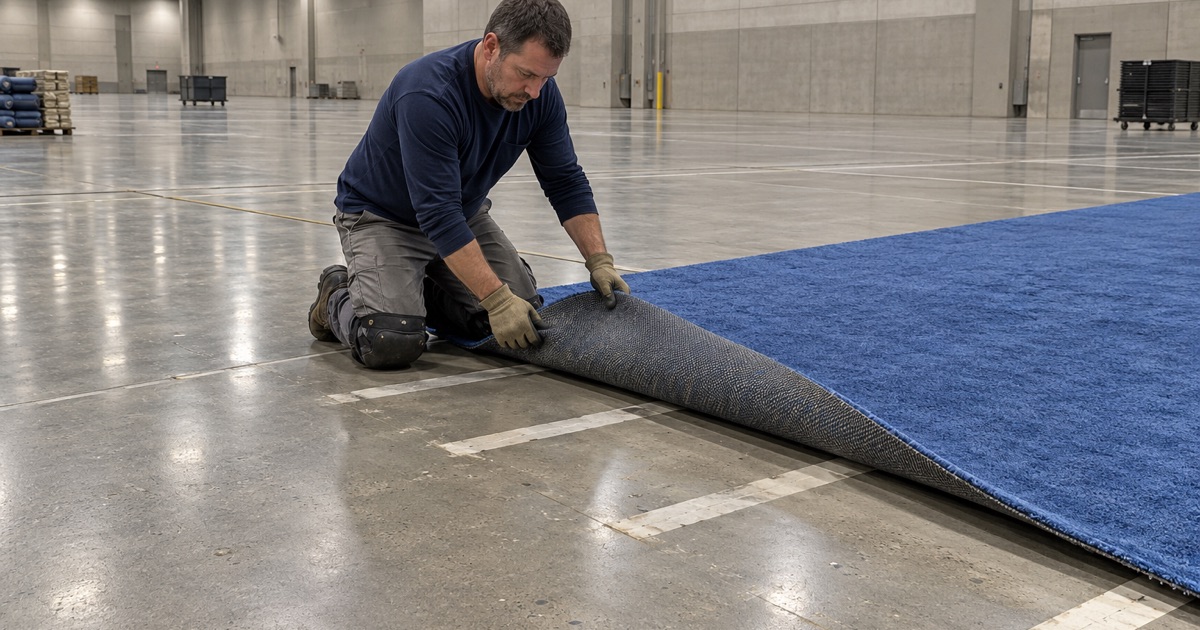
The scale makes the rule matter. The expansion that opened May 16, 2024 brought exhibit space to about 300,000 square feet, and every booth laid on that floor starts with carpet held down by double-sided tape. Multiply that by a full show calendar, and the concrete beneath sees more adhesive applied and peeled in a season than most commercial floors see in years of ordinary service.
Tape and Tape Residue Are the Decorator’s Job
The kit makes the contracted decorator responsible for removing all tape and tape residue from the exhibition halls, pre-function areas, ballroom and meeting room floors. It goes further: any damage caused to a surface by the tape, or by the tools used to remove it, is subject to a fee. The kit gives no dollar figure, but the principle is plain enough that every floor owner downtown should borrow it.
We read that rule as a performance test the floor has to pass after every event. Note what the kit does not do: it approves tapes, not floor coatings, and it rates no coating system at all. So the burden of choosing a floor that survives the cycle sits with the venue owner, the hotel or the building manager, and that is the decision we help with.
Looking for epoxy-flooring closer to Sussex? See Epoxy-Flooring in Sussex.
Residue, Scrapers and the Cost of a Messy Move-Out
Move-out at a downtown venue is fast. Crews peel carpet, pull tape lines and attack whatever residue stays behind with whatever is on the cart, often while the next show waits at the loading dock on N. Sixth Street. A floor coating in that setting has to tolerate three things at once: the pull of the tape itself, the solvent in an adhesive remover, and the edge of a scraper.
Adhesive Removers and Soft Coatings
Citrus and solvent-based adhesive removers are standard kit for decorator crews, and a coating that is undercured, too thin or chemically soft can swell or dull where they sit. Fully cured 100% solids epoxy under a polyaspartic or polyurea topcoat generally holds up better than a thin water-based roll-on. We specify chemical resistance for the removers your crews actually use, and we ask for the product names before we quote.
Dwell time matters as much as the chemistry. A remover left under a rag overnight is a different exposure than one wiped off in two minutes, and we write the cleanup guidance into the handover so housekeeping and decorator crews know what the floor tolerates. That turns a vague maintenance note into a rule a venue can enforce on the next contractor who arrives with a squeeze bottle.
Scrapers, Blades and Floor Machines
Residue that will not wipe off gets scraped, and a steel blade held at a steep angle will gouge a soft or thin coating. A quartz aggregate broadcast or a thicker build gives the surface more body to absorb that abuse, while a smooth high-gloss film shows every scrape. We talk through which texture your crews and your cleaning machines can live with before a finish is picked.
Glitter, confetti, sand and simulated snow are a related problem. At the Baird Center they need district approval and carry a cleaning fee, which tells you how hard they are to get out of a floor. A tight, nonporous topcoat with sealed joints gives that debris nowhere to lodge, so a ballroom floor can be cleaned the night of an event rather than over two days.
Bond Strength: Why a Weak Coating Leaves With the Tape
Double-sided carpet tape is designed to grip hard, and when a crew peels it, that grip pulls up on whatever it is stuck to. If the coating’s bond to the concrete is weaker than the tape’s bond to the coating, the coating comes up in strips. That failure is almost always set in place on installation day, by preparation, moisture or curing, not by the tape brand.
Mechanical Profile, Never Acid
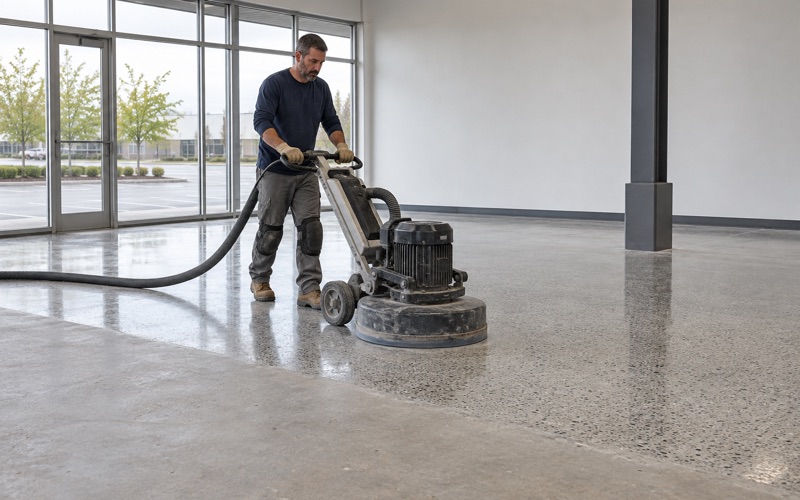
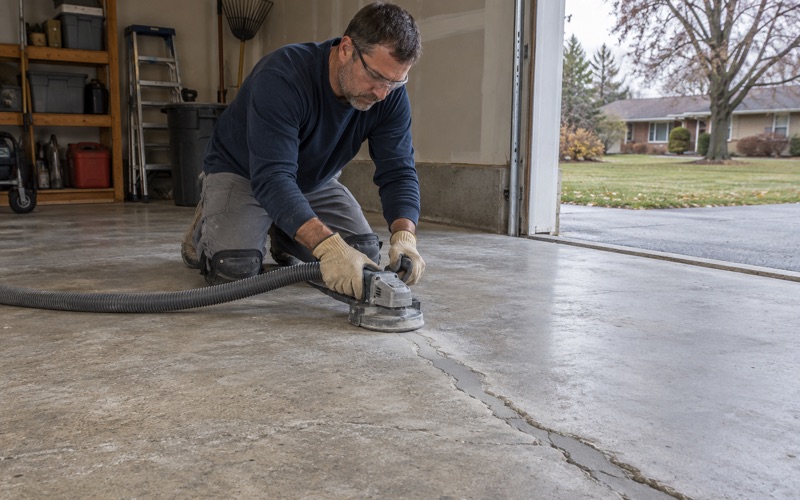
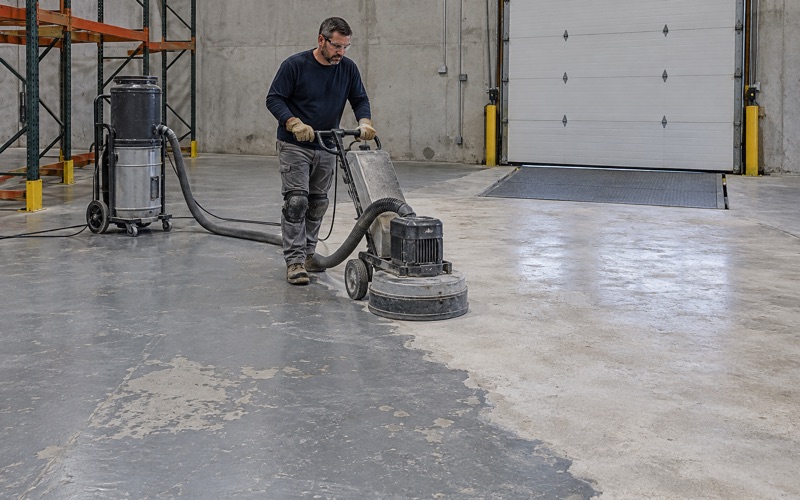
We open every slab with a diamond grinder or a shot blaster to a measured ICRI CSP profile suited to the system, and we never acid etch. Acid leaves a weak, inconsistent surface and salts that undermine adhesion, which is exactly what tape will find. Dust and slurry are collected on site and never washed into a floor drain or a storm sewer, which matters in a working venue.
Old coatings get the same scrutiny. Before quoting, we check whether an existing film is firmly bonded or already lifting at the edges, and we look closely at cracks and joints. If a slab needs repair or replacement before it can carry a coating, we say so plainly. Putting a new system over a failing one only moves the weak layer up to where the tape will reach it.
Moisture Testing Before Any Coating
Vapor pushing up through a slab breaks the bond from below, and a floor that looks dry can still be wet. We write moisture testing into the scope using ASTM F2170 in-situ relative humidity probes or ASTM F1869 calcium chloride testing, with an ASTM D4263 plastic sheet check as a quick screen. Where readings run high, a moisture-mitigation primer goes into the system rather than being sold later.
Large venues rarely sit on one uniform slab. Additions, patched trenches and rooms over different subgrades can read differently, so we test in more than one location and map the results before deciding where a mitigation primer belongs. We also do not sell a floor coating as a fix for water coming up through a slab; that problem gets named as its own repair.
Cure to the Slab, Not the Calendar
A coating reaches its full chemical resistance and adhesion only after a full cure, and an event floor taped too early is being tested before it is finished. We schedule curing against slab temperature and the dew point spread at the slab surface, watching for amine blush that weakens intercoat bonds. Then we give the venue a firm date when tape, carpet and lifts can return.
Venues rarely go dark for long, so we plan installs around the event calendar the way we plan industrial work around production: overnight windows, weekend gaps and the quiet weeks between seasons. Sequencing a ballroom, then the pre-function corridor, then back-of-house lets one area cure while the next is prepped, and it keeps load-in paths open for the operations team.
No Anchors, No Drilling and Other Downtown Floor Questions
The kit is blunt on another point: any anchoring or drilling into the exhibit floor or any other surface within district facilities is strictly prohibited. Utility floor pockets carry power and data instead, and only district electricians may open them. For a floor contractor, that means the floor has to work around fixed services rather than having new penetrations punched through it for each show.
Utility Floor Pockets and Their Edges
Pocket lids, frames and the concrete around them are where coatings most often chip, because those edges see foot traffic, lid handling and cart wheels. We feather and terminate the system cleanly at each frame instead of flooding into the pocket, so an electrician can lift a lid without breaking the coating. Any drilling for our own work is agreed with the facility in advance.
Joints Under Forklifts and Lifts
Move-in brings forklifts, scissor lifts and pallet jacks across the same joints dozens of times a day. Those joints are filled with a semirigid filler before any coating goes over them, so wheels roll across a supported edge instead of breaking it. The same detail serves service corridors and freight elevator lobbies, where loaded carts strike the joint every few minutes during a busy load-in.
Ballroom, Pre-Function and Back-of-House Floors
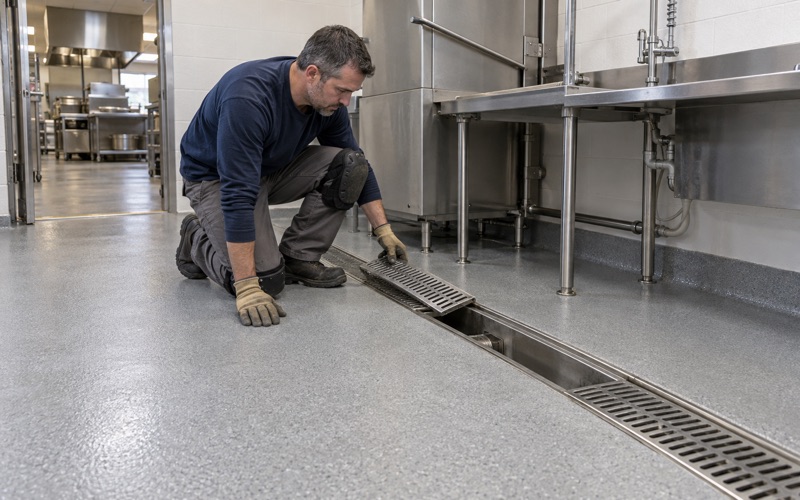
The tape rule in the kit reaches beyond the exhibit hall to pre-function, ballroom and meeting room floors, and hotels and smaller venues downtown run the same cycle. Back-of-house kitchens and service halls add grease, hot water and heavy carts. There we lean toward urethane cement with a coved base, and we plan around City of Milwaukee Health Department requirements for any food area.
Permits and Who Signs Off
Downtown Milwaukee is a neighborhood of the City of Milwaukee, so building permits and inspections run through the city’s Department of Neighborhood Services, and commercial buildings here fall under the Wisconsin Commercial Building Code. Before scheduling, we ask the local inspector whether a floor job needs a permit. Venue operators often add their own rules, and we read those before the proposal is written.
If your hall, ballroom or service floor has started coming up with the tape, or you are planning a new floor ahead of a show season, we can test the slab and the existing coating and tell you which system will hold. The answer may be a full grind and rebuild, a slab repair first, or a fresh topcoat over a base that is still sound.
- 20+ Years on Concrete
- Moisture Testing in Every Scope
- Written Contract Before Any Deposit