
New Berlin Epoxy Flooring provides concrete grinding in New Berlin, WI, serving surrounding cities including Hales Corners, West Allis, Greenfield, Brookfield and Waukesha. In more than 20 years of floor work, we have found that preparation decides more about how a floor performs than any product on the label, so grinding is the part of the job we refuse to rush.
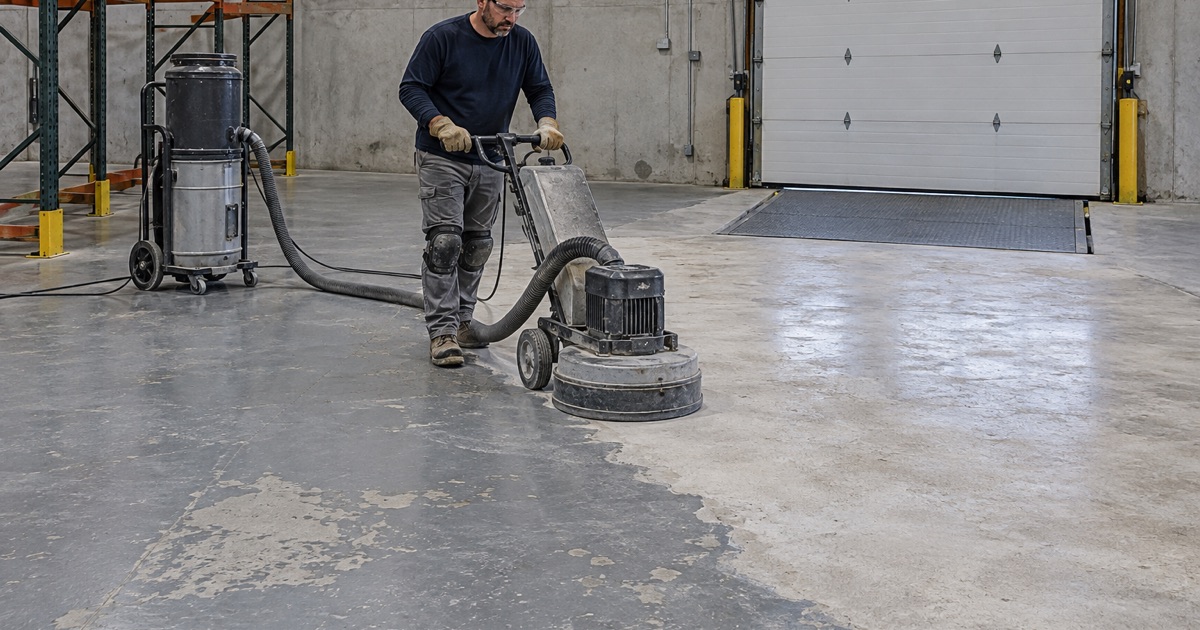
Concrete grinding uses rotating diamond tooling to cut into the surface of a slab. It removes coatings, adhesives, sealers and the weak top layer, flattens high spots and leaves a clean, open profile that a primer can grip. We also shot blast where the slab and the system call for it. We never acid etch.
We grind ahead of our own coatings and polished concrete, and as a stand-alone service for owners and other flooring trades who need a slab cleaned up and made ready. Every job uses dust collection at the machine, and slurry from wet work is bagged on site rather than washed into a floor drain or storm sewer.
Surface Profiles and Why They Matter
The ICRI Profile Scale
The International Concrete Repair Institute describes surface roughness on a scale from CSP 1, nearly flat, to CSP 10, very rough. Thin sealers and coatings need a light profile, typically around CSP 1 to 3, while thick slurries, overlays and trowel-applied mortars need a heavier one. Matching the profile to the system is part of the specification, not a guess.
Too smooth a profile leaves the coating with nothing to hold onto. Too rough a profile can show through thin coatings and waste material filling the grooves.
Diamond Grinding
Diamond grinding uses metal-bond or resin-bond diamond segments on planetary or rotary grinders. It is precise, controllable and well suited to garages, basements, retail and office floors and to removing thin coatings. It also flattens the slab as it profiles, which helps decorative and polished finishes.
Shot Blasting
Shot blasting throws steel shot at the slab and recovers it by vacuum, leaving a uniform textured profile. It is fast on large open floors such as warehouses and plants, and it is effective at opening hard, dense slabs for thick industrial systems. It does not flatten the floor, so it is often paired with grinding at edges and high spots.
In industrial park buildings, including those in the New Berlin Industrial Park, shot blasting lets us prepare large areas inside a weekend or a shutdown week. We plan the zones with your staff so production keeps running in the rest of the building.
Edges, Corners and Stairs
Large grinders cannot reach the last few inches along walls, around columns, inside floor drains or on steps. We finish those areas with hand grinders fitted with dust shrouds, so the profile at the edge matches the field. Edges left smooth are where coatings start to peel, which is why we treat them as part of the job rather than an afterthought.
Removing What Is Already on the Floor
Paint, Sealers and Old Coatings
Garage and basement floors often carry old paint, failing epoxy or clear sealers that prevent a new coating from bonding. We remove them with aggressive metal-bond tooling or, for thick coatings, specialized removal tools and shot blasting. Before quoting, we check how well the old coating is holding and how thick it is, because that drives the time involved.
A coating applied over an old one that is partly loose will fail with it. Removal is the only reliable path when a previous coating is peeling.
Adhesives, Mastic and Thinset
Removing carpet, vinyl, VCT or tile leaves glue, mastic and thinset that new flooring or coatings cannot bond over. Grinding takes them down to clean concrete. Some older black mastics may contain asbestos, and those need testing and a qualified abatement contractor before any grinding happens, so we ask about the age of the flooring before starting.
Oil and Contamination
Oil, grease and coolant soak into concrete around machines, in garage parking spots and in auto shops. Light contamination can be removed with degreasing and grinding, while deeply soaked areas may need repeated cleaning or deeper removal before they will accept a coating. We identify those areas during the walk-through.
Flattening and Leveling
High Spots, Lippage and Trip Edges
Grinding can take down high spots, raised edges at joints and small trip hazards. That matters for decorative floors, polished concrete and any space where people or carts move across joints. OSHA’s walking-working surfaces rule, 29 CFR 1910.22, expects employers to keep floors free of hazards, and a raised edge at a joint is one of the most common.
Low Areas and Fills
Grinding cannot raise a low spot. Dips, ponding areas and hollows are filled with patching mortar or self-leveling material after grinding, then ground again where needed to blend them in. Large settled sections usually indicate a base problem, and we tell you plainly when a slab needs repair or replacement before it can be finished.
Dust, Slurry and the Job Site
Dust Collection at the Grinder
Concrete dust contains respirable crystalline silica, which OSHA regulates. Our grinders run with industrial dust extractors and shrouds, and we vacuum as we work so the dust is captured at the source rather than swept up afterward. Adjacent rooms and production areas can usually keep working.
Slurry From Wet Work
Some polishing and grinding steps use water, which produces a cement slurry. We collect it with a wet vacuum or squeegee, let it settle and bag the solids for disposal. None of it is washed into a floor drain or storm sewer, where concrete fines can clog lines.
Moisture Testing After Grinding
Once the slab is open, we test for moisture with the ASTM D4263 plastic sheet test, calcium chloride testing to ASTM F1869 or relative humidity probes to ASTM F2170 when a coating or new flooring is going down. The reading decides which primer, if any, can be used. It also keeps a new floor from becoming the next blistered one.
- 20+ Years on Concrete
- Moisture Testing in Every Scope
- Written Contract Before Any Deposit