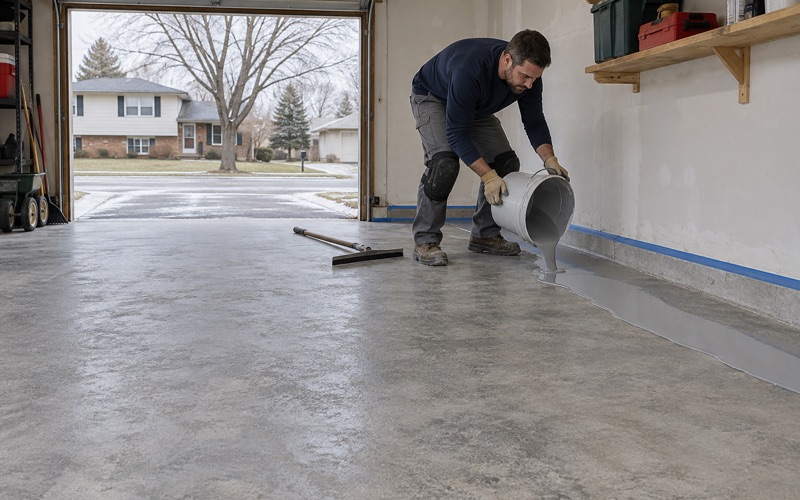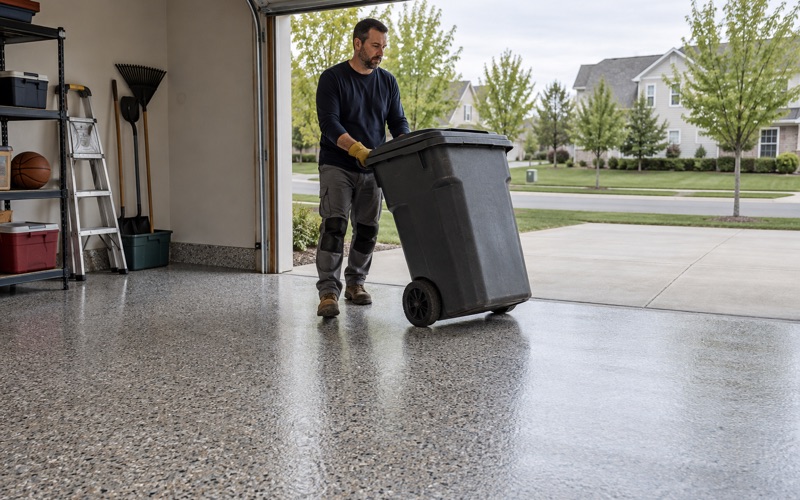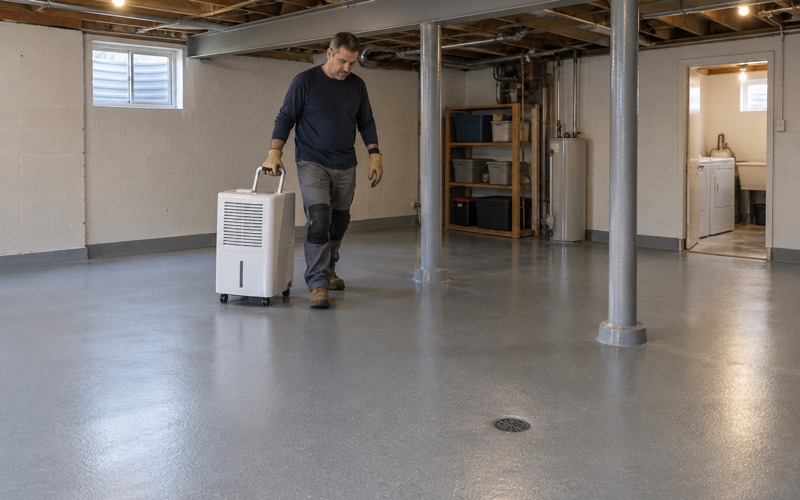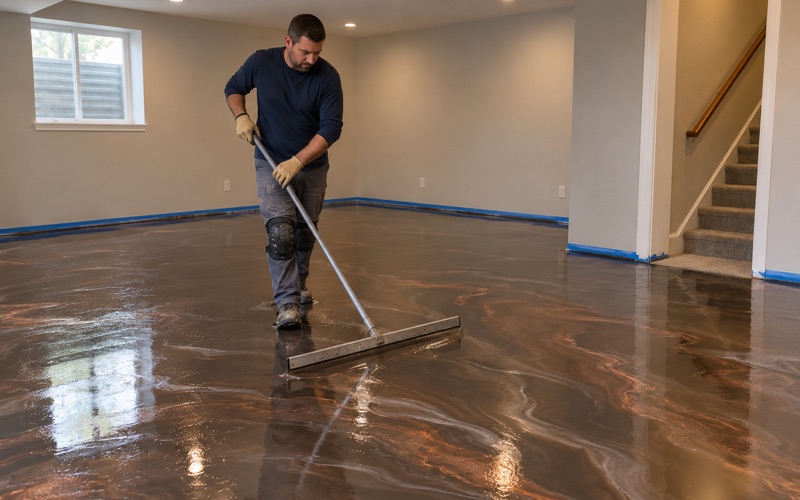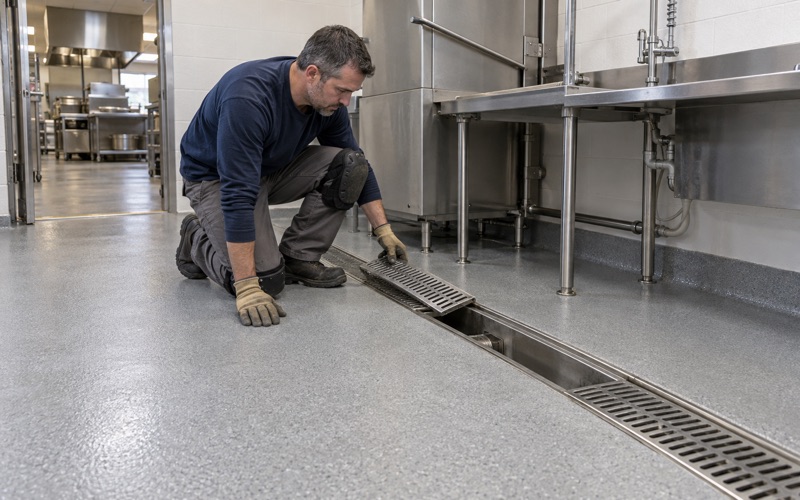
New Berlin Epoxy Flooring brings more than 20 years of experience to epoxy flooring in Cedarburg, building garage, basement and storage-room floors that are meant to be cleaned, not just admired. Our systems run from 100% solids epoxy base coats to polyaspartic and polyurea topcoats, with a vinyl flake or quartz aggregate broadcast where traction or texture is wanted. Each one begins on a slab we have opened mechanically and tested.
A floor coating is only as good as the concrete under it, so we read the cracks, the joints and any old coating before we put a number on paper. When a slab needs repair or replacement before it can carry a coating, we say so plainly. The proposal then names the product, the system build and the finished thickness, so the floor that goes down can be checked against the one that was quoted.
This page is about one practical job a good floor does in a Cedarburg home: it shows spilled bird seed and pet food and lets you remove every bit of it. That sounds minor until you know where pantry moths and mice find their meals. The sections below follow the seed from a historic feed store to a garage corner, and explain how we build a surface that sweeps and vacuums out completely.
A Feed Store in a Stone Gristmill, and the Moth That Rides Home
The Cedarburg Mill on Columbia Road
The Cedarburg Mill is a five-story stone gristmill built in 1855 by Frederick Hilgen and William Schroeder, with lower walls 32 inches thick and a monitor roof. In its working years it could grind up to 120 barrels of flour a day. The building has been some type of feed store since it was constructed, and it is listed on the National Register of Historic Places.
Today the mill at N58 W6181 Columbia Road is home to Landmark Feed, Seed & Supply. The store sells feed for horses, dogs, cats, small animals and fish, along with dozens of custom wild-bird seed mixes and straight seed such as black oil sunflower, safflower and thistle. Its annual bird seed sale is a fixture for anyone in town who keeps a feeder stocked through the year.
What comes home in the bag
A sale like that sends a lot of seed home in a short stretch of weeks, and most of it ends up stacked in a garage, a mudroom or a basement corner next to the dog food. Nothing about that is careless; it is simply where bulky bags fit. It is also exactly the storage pattern extension entomologists point to when a household starts noticing small moths.
None of this is a comment on any particular store or any particular bag. Bird seed and dry pet food are stored products, and stored grain products of every kind, wherever they are bought, can carry the eggs or larvae of insects that feed on them. The point is not to stop buying seed in bulk. It is to store it, and to finish the floor beneath it, so that a problem has nowhere to settle.
How the Indian meal moth travels
The UW-Madison Insect Diagnostic Lab lists bird seed and dry pet food among the foods Indian meal moth larvae feed on, and notes that the moths usually come from the store in pet food or dried plant products. Its advice begins with checking closets for bags of pet food. The lab also says that most home problems can be solved with sanitation alone.
The detail that matters for a floor is what happens next. According to the same guidance, mature larvae usually leave their food supply and wander about looking for a place to pupate. A larva that crawls off a seed bag on a garage shelf drops to the slab beneath it, and whatever that slab offers in gaps and grit becomes its next hiding place.
Looking for epoxy-flooring closer to Grafton? See Grafton Epoxy-Flooring.
Where Spilled Seed Goes on Bare Concrete
Cracks and crevices
The diagnostic lab’s sanitation advice is specific: use a vacuum cleaner to get into cracks and crevices and remove the adults, larvae and eggs. On a bare garage slab, those cracks are everywhere. Shrinkage cracks, spalled edges and the gap where the slab meets the foundation wall all collect sunflower hulls, millet and crumbs of kibble that a broom pushes deeper instead of lifting out.
Once seed is lodged there, it keeps feeding larvae long after the torn bag has been thrown away. It feeds mice, too. The Connecticut Agricultural Experiment Station recommends storing pet food and wild bird seed in airtight containers so rodents cannot get at it or cache it, and a cracked slab hands them a supply of spilled kernels right at floor level.
Open control joints
Saw-cut control joints are meant to be there; they let concrete crack where it is told to. Left open, though, each joint is a narrow straight channel that runs the full width of the garage. Seed rolls into it, dust packs on top, and a vacuum nozzle passing over the surface never reaches the bottom. Over a few winters, the joint turns into a small seed bank.
Rough, dusty concrete
Unsealed concrete also sheds its own dust. The surface paste wears, the aggregate shows through, and a fine gray powder settles into every low spot. That powder is close to the color of most seed mixes and dry pet food, which makes a spill nearly invisible until someone kneels down to look for it. By then it has been tracked under shelving and into the corners.
Porous concrete soaks up oil from crumbled kibble and dust from cracked seed as well, leaving a stained, rough surface that never quite looks clean. Owners often stop sweeping a floor like that, because sweeping it does not seem to change anything. A floor that looks the same before and after cleaning soon stops getting cleaned at all, which is the opposite of what a storage floor should encourage.
Sanitation Is the Fix: A Floor That Vacuums Clean
Opening the slab without acid
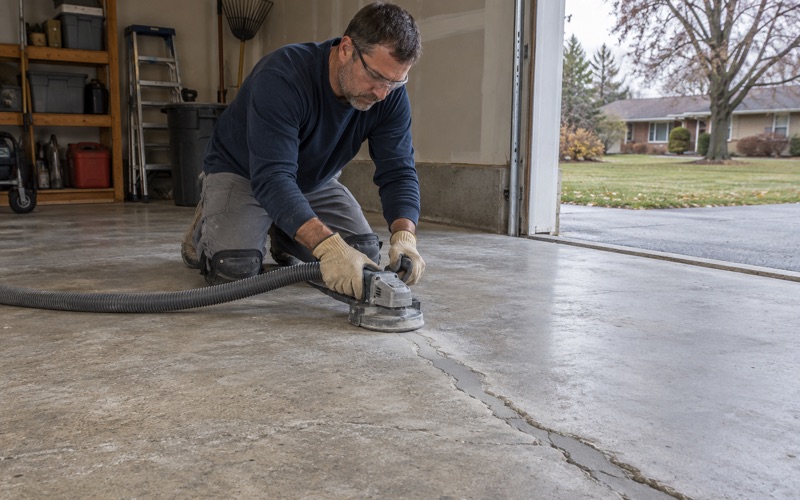
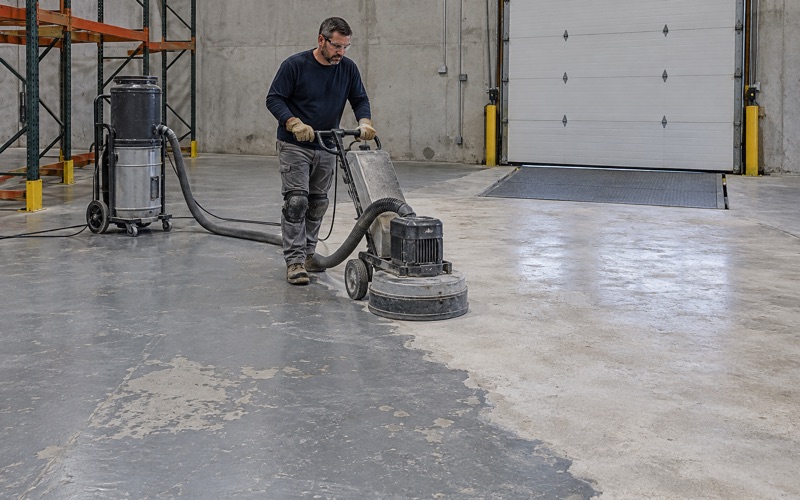
We never acid etch. Every slab is opened with a diamond grinder or a shot blaster to the ICRI surface profile the chosen system calls for, which removes the weak, dusty paste and gives the primer something sound to grip. Grinding dust and slurry are collected on site by the equipment’s own vacuum, and they are never washed into a floor drain or out onto the driveway.
Closing cracks and joints first
A crack-free floor is built, not painted on. Cracks are routed and filled, spalled edges are rebuilt, and joints are filled with a semirigid joint filler before any coating goes over them, so the finished surface has no channel for seed to roll into. If a crack is still moving, or a section has heaved, we tell you before the job is sold rather than coating over it.
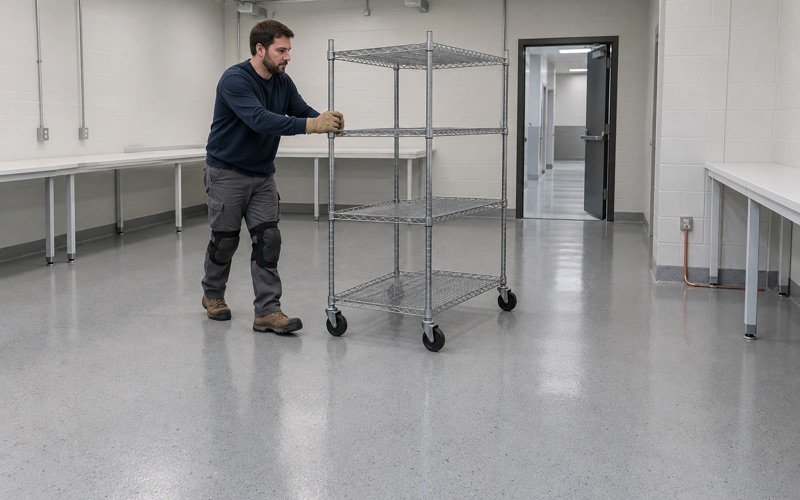
That prep is where most of the cleaning benefit comes from. A coating laid over open cracks simply telegraphs them, and within a season the seams reopen. Closing them first lets the finished floor run as one continuous surface from the overhead door to the back wall, with no seam for hulls to hide in and nothing for a vacuum nozzle to chase.
A light, sealed surface that shows every spill
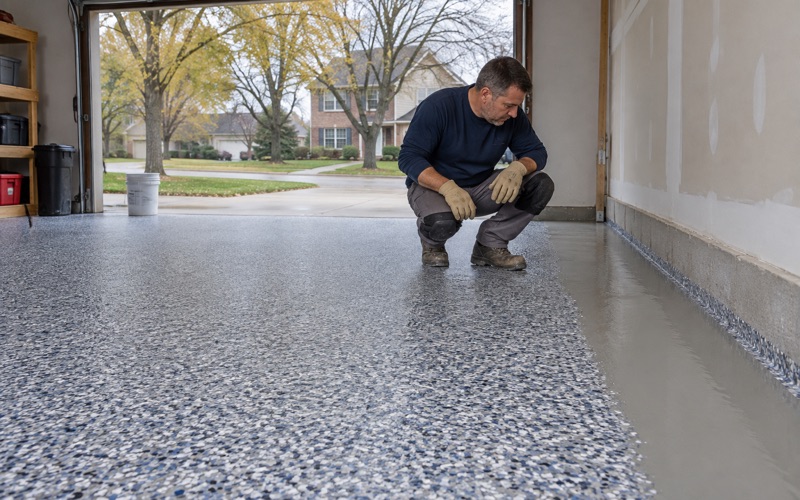
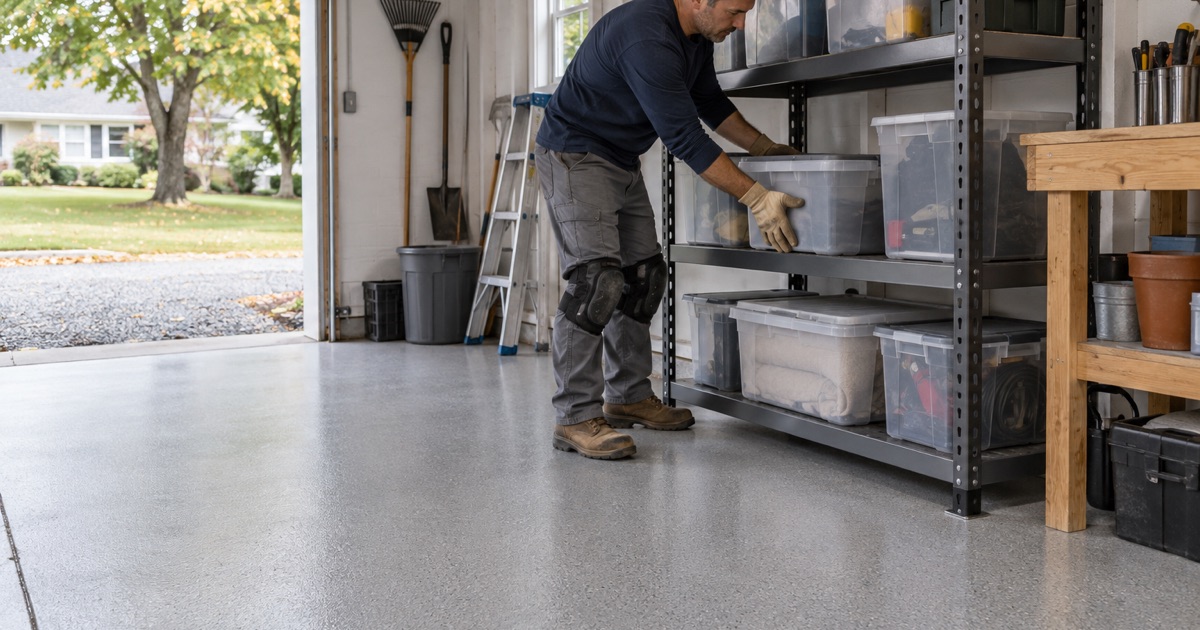
For a storage area we usually suggest a light-colored base coat with a fine flake or quartz broadcast and a clear polyaspartic topcoat. Dark seed and brown kibble stand out against it immediately, so a spill gets cleaned up the day it happens. A sealed surface also stops the slab from shedding its own dust, which means what you see on the floor is only what was dropped.
Be clear about what a coating does not do. It does not kill larvae, and it does not repel moths or mice. What it does is take away the hiding places and make the sanitation the extension lab recommends easy and complete, which is where the real control comes from. Airtight bins for the seed and the kibble do the rest of the work.
Cedarburg Garages That Hold the Seed and the Kibble
A city of detached houses
Cedarburg is a city of about 12,000 people in Ozaukee County, roughly 20 miles north of Milwaukee. Detached single-family houses make up 62.5 percent of its housing units, and 94.0 percent of owner-occupied homes are detached houses. In most of those homes the garage is the pantry overflow, the place where a big bag of black oil sunflower seed sits beside the dog food.
The housing stock spans a long run of building eras, from 652 units built in 1939 or earlier to 685 added between 2010 and 2019. Older slabs tend to carry decades of cracks and old paint, while newer ones may look perfect and still hold moisture. Either way, we inspect before we quote, and the quote reflects what that particular slab actually needs.
Testing an attached garage slab
Wisconsin’s Uniform Dwelling Code does not require a vapor retarder under an unconditioned attached garage slab, so a dry-looking garage floor is not necessarily a dry one. We write moisture testing into the scope on garage and basement slabs alike, using an ASTM D4263 plastic sheet test, ASTM F1869 calcium chloride readings or ASTM F2170 in-situ relative humidity probes as the slab calls for.
When the readings come back high, a moisture-mitigation primer goes into the system, or we recommend against coating at all. Warranty exclusions are read out before the job is sold, with moisture from below named first. We also do not sell a floor coating as a fix for water coming up through a slab, because a floor that blisters loose helps no one keep seed swept up.
Salt, curing and the paperwork
A Cedarburg garage also takes the road salt and calcium chloride brine that winter tracks in on the tires. We build garage floors for that, with a topcoat chosen to stand up to deicers and hot tire pickup. Curing is scheduled against slab temperature and the dew point spread at the surface rather than the calendar, and an unheated garage waits for spring when it has to.
Every home job gets a written contract before a deposit is taken, with the products and any warranty written into it, in keeping with Wisconsin’s ATCP 110 home improvement practices rules. We also ask the City of Cedarburg or the local inspector whether a job needs a permit before it is scheduled. Then the seed bags can go back onto a floor that shows every kernel.
- 20+ Years on Concrete
- Moisture Testing in Every Scope
- Written Contract Before Any Deposit